
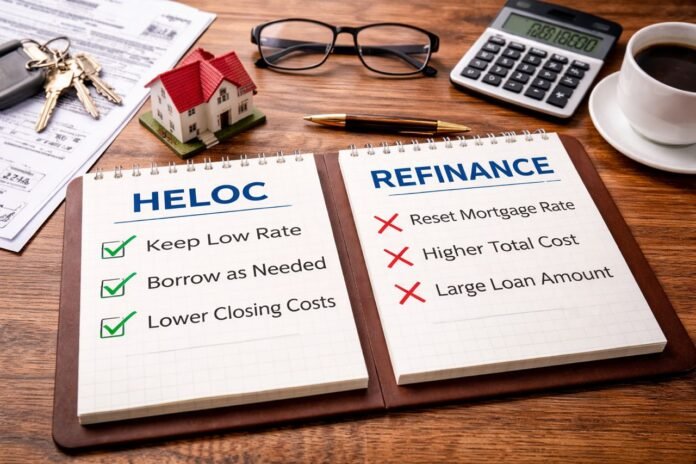
For years, refinancing was the go-to move when homeowners wanted to lower payments or tap into equity.
That’s changed.
Today, more homeowners are turning to HELOCs instead of refinancing and the shift makes sense when you look at the math.
Let’s break down why this trend is growing and when it actually makes sense.
1. Many Homeowners Already Have Low Mortgage Rates
Millions of homeowners locked in ultra low mortgage rates in 2020-2022.
If your current mortgage sits at 3%, refinancing into a new loan at 6% or 7% simply to access equity doesn’t make financial sense. You’d be replacing cheap long term debt with expensive long term debt.
A HELOC allows you to keep your original mortgage intact while borrowing only what you need.
That flexibility is a major reason homeowners are shifting strategies.
2. HELOCs Let You Borrow Only What You Need
When you refinance with a cash out loan, you receive a lump sum. Whether you need the full amount or not, you’re paying interest on all of it.
A Home Equity Line of Credit works differently. It functions more like a revolving credit line:
- Borrow what you need
- Repay
- Borrow again (during the draw period)
Interest is charged only on the amount used, not the full approved limit.
For homeowners funding renovations, debt consolidation, or staged projects, that flexibility is attractive.
3. Closing Costs Are Often Lower
Refinancing typically involves full mortgage underwriting, appraisal fees, lender charges, and closing costs that can add up quickly.
HELOCs usually have:
- Lower upfront costs
- Faster approval timelines
- Fewer fees (depending on the lender)
While fees vary, many homeowners see HELOCs as a lighter transaction compared to refinancing an entire mortgage.
4. Access to Equity Without Resetting the Clock
Refinancing often resets your loan term to 15 or 30 years.
That means even if you’ve been paying down your mortgage for 8-10 years, you could extend your payoff timeline again.
A HELOC sits alongside your existing mortgage instead of replacing it. You keep your current amortization schedule intact.
For homeowners focused on paying off their primary mortgage sooner, this matters.
5. Debt Consolidation Without Repricing the Entire Loan
Some homeowners are using HELOCs to consolidate high-interest credit card debt.
If your mortgage rate is low, a HELOC may offer a rate significantly lower than credit cards without touching your primary loan.
However, this strategy requires discipline. Moving unsecured debt into a home-secured product increases risk if spending habits don’t change.
6. Rising Interest Rate Environment
In higher-rate environments, refinancing becomes less attractive.
HELOC rates are often variable, which carries its own risks. But for homeowners who need short term access to funds and plan to repay quickly, the flexibility can outweigh the uncertainty.
The key is having a clear repayment plan.
When a HELOC Makes Sense
A HELOC may be worth considering if:
- You have substantial home equity
- You want flexible access to funds
- Your current mortgage rate is significantly lower than today’s market rates
- You plan to repay borrowed funds strategically
When Refinancing Might Still Be Better
Refinancing could be smarter if:
- Current rates are lower than your existing mortgage
- You want predictable fixed payments
- You need a large lump sum
- You’re restructuring the entire loan for long term savings
It’s not about which option is trending. It’s about which option fits your numbers.
Risks Homeowners Shouldn’t Ignore
Before choosing a HELOC, understand:
- Rates are often variable
- Your home is collateral
- Payments can increase if rates rise
- Overspending can lead to long-term financial strain
Used strategically, a HELOC can be a powerful tool. Used casually, it can magnify risk.
More homeowners are choosing HELOCs because they don’t want to give up low mortgage rates just to access equity.
The shift isn’t random. It’s practical.
If you’re weighing your options, compare:
- Your current mortgage rate
- Available refinance rates
- HELOC rates and repayment terms
- Total long term interest costs
The smartest move isn’t the popular one. It’s the one that protects your equity while keeping your long term goals intact.
In another related article, 7 Mistakes Homeowners Make When Refinancing (And How to Avoid Them)