
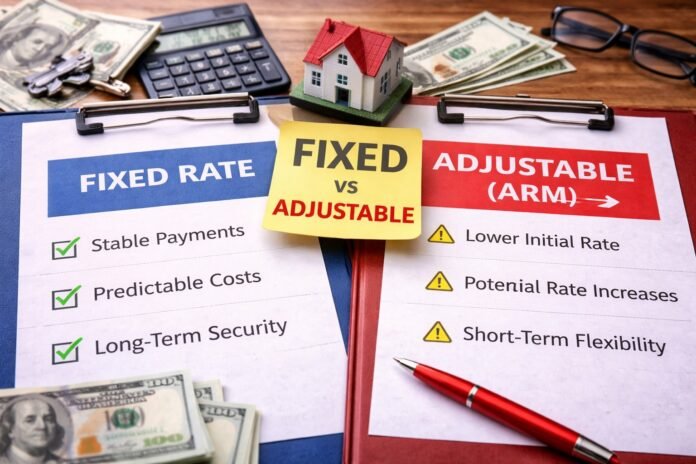
When you refinance you’re not just replacing a loan. You’re choosing how your future payments behave.
And that decision matters more than most people realize.
The difference between fixed and adjustable refinance rates isn’t just about interest. It’s about risk, stability, flexibility and how long you plan to stay in the property.
Let’s walk through it clearly.
Fixed Rate Refinance: Predictability First
With a fixed rate refinance:
- Your interest rate stays the same
- Your principal and interest payment stays the same
- Your payment schedule is predictable
You know exactly what you’re paying today and 10 years from now.
Why People Choose Fixed
- They value stability
- They plan to stay long term
- They want protection from future rate increases
- They prefer simple budgeting
In a volatile rate environment, fixed loans remove uncertainty. That peace of mind has real value.
The Tradeoff
Fixed rates are often slightly higher than initial adjustable rates.
You’re essentially paying a premium for certainty.
Adjustable Rate Refinance (ARM): Flexibility With Risk
With an adjustable rate mortgage (ARM):
- You start with a lower introductory rate
- The rate adjusts periodically after a set term
- Payments can increase or decrease
For example, a 5/1 ARM means:
- Fixed rate for 5 years
- Then adjustments once per year
Why People Choose ARMs
- They plan to move or sell before the adjustment period
- They expect rates to fall
- They want lower initial payments
- They need short term cash flow relief
If your timeline is short, an ARM can make sense.
The Key Question: How Long Are You Staying?
This is the most important factor.
If you’re staying:
- 10+ years – Fixed rate often makes more sense
- 3-5 years – ARM may reduce costs
- Uncertain timeline – Fixed reduces risk
Your personal horizon matters more than market predictions.
What Happens If Rates Rise?
With a fixed loan nothing changes.
With an ARM your rate can adjust upward after the introductory period. Most ARMs have caps that limit how much the rate can increase per adjustment and over the life of the loan.
But “capped” doesn’t mean harmless. Even a few percentage points can significantly change monthly payments.
Before choosing an ARM, ask:
- What’s the maximum possible rate?
- What would that payment look like?
- Could I comfortably afford it?
If the worst case number stresses your budget, that’s a signal.
What Happens If Rates Fall?
If rates drop in the future:
- Fixed rate borrowers can refinance again
- ARM borrowers may benefit automatically at adjustment
But refinancing always comes with costs. Counting on future refinancing to “fix” a risky choice isn’t a strategy. It’s a gamble.
Current Market Reality
In higher rate environments the gap between fixed and adjustable rates can widen.
That makes ARMs look attractive upfront.
But remember: lenders price ARMs lower initially because you’re taking on some of the interest rate risk.
You’re trading short term savings for long term uncertainty.
When Fixed Makes More Sense
Choose fixed if:
- Stability matters more than savings
- Your budget is tight
- You’re staying long term
- You dislike financial unpredictability
When Adjustable Might Make Sense
Consider an ARM if:
- You have a clear short term exit plan
- Your income is expected to grow
- You can handle payment variability
- You fully understand adjustment caps
This isn’t about which loan is “better.”
It’s about which loan aligns with:
- Your timeline
- Your risk tolerance
- Your income stability
- Your long term goals
Fixed rates buy certainty.
Adjustable rates buy flexibility.
Neither is automatically right. The wrong choice is the one that ignores your actual situation.
In another related article, Why More Homeowners Are Using HELOCs Instead of Refinancing