
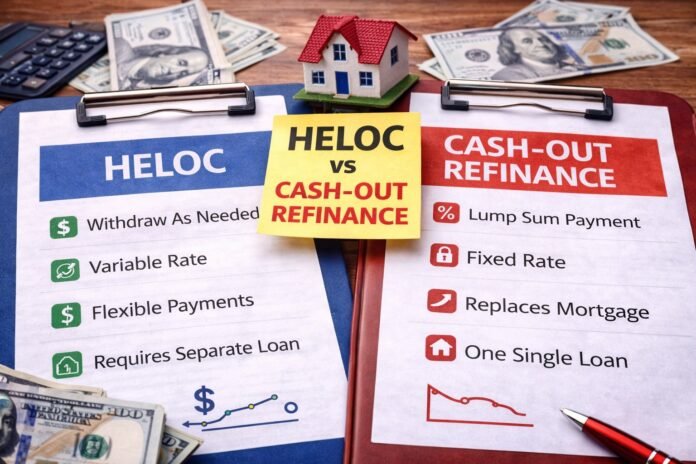
When homeowners need access to equity, the two most common options are a HELOC and a cash out refinance.
Both unlock cash.
Both use your home as collateral.
But long term costs can look very different.
If you’re deciding between the two, the real question isn’t which sounds better. It’s which costs less over time based on how you plan to use it.
Let’s break it down clearly.
First: How They Actually Work
HELOC (Home Equity Line of Credit)
- Works like a credit line
- You borrow only what you need
- Usually has a variable interest rate
- Often includes a draw period (5-10 years)
- Payments may start as interest only
You’re not replacing your primary mortgage. You’re adding a second loan.
Cash Out Refinance
- Replaces your current mortgage
- You take out a larger loan than you owe
- You receive the difference in cash
- Usually fixed rate (but not always)
- One single mortgage payment
You’re refinancing 100% of your balance at today’s rate.
The Long Term Cost Difference
1. Interest Rate Structure
HELOC:
- Often starts lower
- Usually variable
- Can rise over time
Cash-Out Refinance:
- Often fixed
- Stable monthly payment
- Predictable total interest
If rates rise significantly a HELOC can become more expensive than expected. If rates fall, it may become cheaper.
Cash out refinancing locks in cost certainty.
2. Amount of Debt Affected
This is where many people miss the math.
With a HELOC:
- Only the borrowed portion is at the new rate
- Your original mortgage stays untouched
With a cash out refinance:
- Your entire mortgage balance moves to the new rate
If you locked in a low mortgage rate years ago, refinancing could increase interest costs on your full balance, not just the cash you’re pulling out.
That alone can make cash-out refinancing more expensive long term.
3. Loan Term Reset
Cash out refinancing often restarts a 15-year or 30-year clock.
Even if your new rate is reasonable, extending your term can dramatically increase total interest paid over time.
A HELOC typically runs alongside your current loan without resetting it.
That difference matters.
4. Payment Flexibility
HELOC:
- Flexible borrowing
- Can repay and reborrow during draw period
- Variable payment amounts
Cash Out:
- Fixed monthly payment
- Less flexibility
- More structured payoff
Flexibility can save money if used responsibly. It can also increase costs if balances linger.
When HELOC Is Usually Cheaper Long Term
A HELOC often wins when:
- You only need a smaller amount
- You already have a low fixed mortgage rate
- You plan to repay quickly
- You want borrowing flexibility
If you use it short term and pay it down aggressively, total interest paid may be significantly lower.
When Cash Out Refinance Can Be Cheaper
Cash out may make sense when:
- Current mortgage rates are lower than your existing rate
- You want predictable long term payments
- You need a large lump sum
- You prefer one consolidated payment
If you’re improving your rate while accessing equity, that can offset costs.
The Hidden Risk Factor
Both options put your home on the line.
But refinancing increases exposure if:
- You extend your term
- You increase total debt significantly
- You refinance a previously low rate into a higher one
A HELOC increases risk differently through rate volatility.
So the cheaper option depends heavily on rate movement and repayment behavior.
A Simple Reality Check
Ask yourself:
- How much do I actually need?
- How fast will I repay it?
- What is my current mortgage rate?
- What would happen if rates rise 2-3%?
Run those numbers honestly.
The cheaper option in theory can become the expensive one in practice if behavior doesn’t match the plan.
HELOCs are often cheaper in the long run when:
- The borrowing amount is moderate
- The original mortgage rate is low
- The repayment timeline is short
Cash out refinancing may be cheaper when:
- You’re improving your base mortgage rate
- You need stability
- You plan to hold long term
There isn’t a universal winner.
The cheapest option is the one that minimizes total interest while aligning with your repayment discipline and timeline.
In another related article, Fixed vs Adjustable Refinance Rates: What You Need to Know Before Choosing