
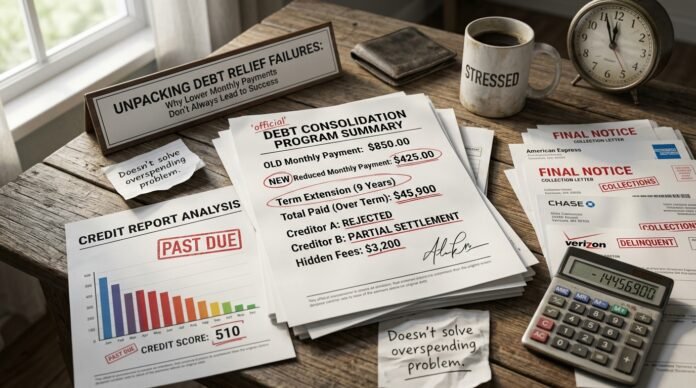
For consumers struggling with overwhelming debt, the promise of a lower monthly payment can feel like a lifeline.
Debt relief programs, debt consolidation loans, settlement arrangements and repayment plans are often marketed around one primary benefit:
“Reduce your monthly payment.”
At first glance, that sounds like exactly what many borrowers need.
When financial stress is high and bills are becoming difficult to manage, lowering monthly obligations can provide immediate breathing room. In many cases, debt relief solutions genuinely help consumers regain control of their finances and avoid more serious financial problems.
However, lower monthly payments do not automatically guarantee financial success.
In fact, one of the most common misconceptions about debt relief is the belief that a smaller payment alone solves the underlying problem. While reduced payments may improve short term affordability, they do not necessarily address the financial habits, structural issues or long term challenges that caused the debt to accumulate in the first place.
This is why some debt relief plans ultimately fail even when they appear successful during the early stages.
Understanding why this happens can help homeowners and consumers make better decisions before committing to a debt relief strategy.
The Appeal of Lower Monthly Payments
Financial stress is often tied directly to cash flow.
When too much income is committed to debt, households may struggle to cover:
- Housing expenses
- Utilities
- Groceries
- Insurance
- Transportation
- Savings goals
In these situations, a lower monthly payment creates immediate relief.
Consumers may suddenly find:
- More room in their budget
- Less pressure from creditors
- Improved short term financial stability
This is one reason debt relief programs can be highly effective.
The problem arises when borrowers assume that lower payments automatically mean debt problems have been solved.
Debt Relief Changes the Structure of Debt Not Necessarily the Cause
Many debt relief strategies focus on restructuring obligations.
Examples include:
- Debt consolidation
- Debt management plans
- Settlement arrangements
- Extended repayment schedules
- Home equity borrowing used to repay consumer debt
These approaches can change:
- Interest rates
- Payment amounts
- Repayment timelines
What they do not automatically change is financial behavior.
If the habits that created the debt remain unchanged, the underlying problem often remains as well.
Why Financial Habits Matter More Than Most People Realize
Debt rarely develops overnight.
In many cases, it results from a combination of:
- Spending patterns
- Budgeting challenges
- Unexpected expenses
- Insufficient savings
- Lifestyle inflation
A debt relief plan may address the balance itself.
It may not address the behaviors that created the balance.
This distinction is critical.
Without meaningful changes, borrowers sometimes find themselves accumulating new debt while still repaying old debt.
The False Sense of Financial Progress
Lower monthly payments can create an illusion of improvement.
Consumers may feel financially healthier because:
- Bills are easier to manage
- Collection calls stop
- Cash flow improves
While these outcomes are positive, they can also reduce the urgency to address deeper financial issues.
The result is a dangerous mindset:
“The problem is fixed.”
In reality, the debt may simply be organized differently.
When Lower Payments Extend Debt for Years
One common way lenders reduce payments is by extending repayment periods.
For example:
Instead of paying off debt over a shorter timeframe, borrowers may be offered significantly longer repayment schedules.
This approach lowers monthly obligations but often increases the total time spent in debt.
Why This Matters
Longer repayment periods can mean:
- More interest paid over time
- Slower financial progress
- Delayed wealth building
- Reduced flexibility
A payment that feels comfortable today may result in years of additional debt obligations.
For some borrowers, this tradeoff is worthwhile.
For others, it simply delays financial recovery.
Debt Consolidation Isn’t a Cure-All
Debt consolidation is one of the most widely used debt relief strategies.
The concept is straightforward:
Multiple debts are combined into a single payment.
Potential benefits include:
- Simplified finances
- Lower interest rates
- Improved organization
- Better cash flow
These advantages can be valuable.
However, debt consolidation does not automatically eliminate debt.
The Common Mistake
After consolidating debt, some consumers continue using:
- Credit cards
- Personal loans
- Other borrowing products
The result can be two separate debt burdens:
- Consolidated debt
- Newly accumulated debt
This is one of the most common reasons debt consolidation efforts fail.
Why Emergency Savings Matter
Many debt relief plans focus exclusively on repayment.
Savings often receive little attention.
This creates a vulnerability.
Without emergency reserves, unexpected expenses may force consumers to borrow again.
Examples include:
- Medical bills
- Car repairs
- Home maintenance
- Temporary income disruptions
When emergencies occur, borrowers who lack savings often return to the same credit products that contributed to their original debt problems.
The cycle begins again.
The Emotional Side of Debt Relief
Debt is not only a financial issue.
It is also an emotional one.
Many consumers enter debt relief programs feeling:
- Overwhelmed
- Anxious
- Frustrated
- Exhausted
When monthly payments decrease, emotional relief often follows.
This psychological improvement can be valuable.
However, it can also lead to complacency.
Some borrowers become less focused on long term financial goals once immediate pressure disappears.
The debt becomes easier to manage but not necessarily easier to eliminate.
Income Problems Cannot Always Be Solved Through Debt Relief
Debt relief strategies primarily address liabilities.
They do not directly address income challenges.
For households facing:
- Wage stagnation
- Reduced work hours
- Job instability
- Rising living costs
lower monthly payments may provide temporary assistance without creating lasting financial security.
In these situations, improving income may be just as important as restructuring debt.
Lifestyle Inflation Can Undermine Debt Relief
Lifestyle inflation occurs when spending increases alongside income growth.
Consumers often experience:
- Salary increases
- Bonuses
- Higher household earnings
Yet financial progress remains limited because spending rises simultaneously.
When this behavior continues after entering a debt relief plan, debt reduction often slows dramatically.
The opportunity to accelerate repayment may be lost.
Homeowners Face Unique Risks
Many homeowners use home equity products to consolidate high-interest debt.
Common examples include:
- HELOCs
- Home equity loans
- Cash out refinancing
These options may offer lower interest rates than credit cards.
As a result, they can create meaningful monthly savings.
The Important Tradeoff
Credit card debt is generally unsecured.
Home equity debt is secured by the home.
This changes the risk profile.
If financial problems persist after consolidation, the consequences may become more serious because the debt is now tied to the property.
For homeowners, understanding this tradeoff is essential.
Why Unrealistic Expectations Lead to Failure
Some borrowers expect debt relief to produce immediate transformation.
They assume:
- Financial stress will disappear.
- Savings will grow automatically.
- Debt will vanish quickly.
Unfortunately, debt relief is often a process rather than a solution.
The most successful outcomes typically involve:
- Patience
- Consistency
- Budgeting discipline
- Long term planning
Expecting instant results can create disappointment and frustration.
Signs a Debt Relief Plan May Be Struggling
Several warning signs often indicate that a debt relief strategy is losing effectiveness.
New Debt Is Being Added
Accumulating new balances during repayment is a major concern.
Savings Remain Nonexistent
Lack of emergency reserves increases future borrowing risk.
Spending Habits Have Not Changed
Debt reduction becomes difficult when financial behavior remains unchanged.
Payments Feel Easier but Balances Decline Slowly
Long repayment timelines can mask limited progress.
Financial Stress Quickly Returns
Recurring financial pressure often signals unresolved issues.
What Successful Debt Relief Looks Like
Effective debt relief involves more than lower payments.
Successful outcomes typically include:
Reduced Debt Balances
The principal steadily declines.
Improved Financial Habits
Spending aligns more closely with financial goals.
Growing Emergency Savings
Financial resilience improves.
Less Reliance on Credit
Borrowing becomes less necessary.
Greater Long Term Flexibility
More income becomes available for future goals.
These indicators suggest genuine financial improvement rather than temporary relief.
The Difference Between Relief and Recovery
One of the most important distinctions consumers can make is understanding the difference between relief and recovery.
Relief means:
- Immediate pressure decreases.
- Payments become manageable.
Recovery means:
- Financial stability improves.
- Debt declines consistently.
- Future borrowing becomes less necessary.
Many debt relief plans successfully provide relief.
The challenge is ensuring they also support recovery.
Questions to Ask Before Entering Any Debt Relief Plan
Before committing to a debt relief strategy, consumers should consider:
Will this reduce debt or simply reorganize it?
How long will repayment take?
What will the total cost be?
What changes will prevent future debt accumulation?
Am I addressing both the debt and the reason it occurred?
The answers often determine whether a debt relief plan succeeds or struggles.
Debt relief plans can be valuable tools for consumers facing financial pressure. Lower monthly payments may improve cash flow, reduce stress and create opportunities to regain control of household finances. In many situations, these programs play an important role in helping borrowers avoid deeper financial difficulties.
However, lower payments alone do not guarantee success. Debt relief changes the structure of debt, but it does not automatically address spending habits, emergency preparedness, income challenges or long term financial behavior.
The most successful debt relief strategies combine affordability with lasting financial change. They help consumers not only manage debt more comfortably but also reduce balances, build savings, and avoid repeating the same borrowing patterns.
Ultimately, true financial progress comes not from making debt easier to live with, but from creating a path toward needing less debt in the future. That distinction is often the difference between temporary relief and lasting financial recovery.