
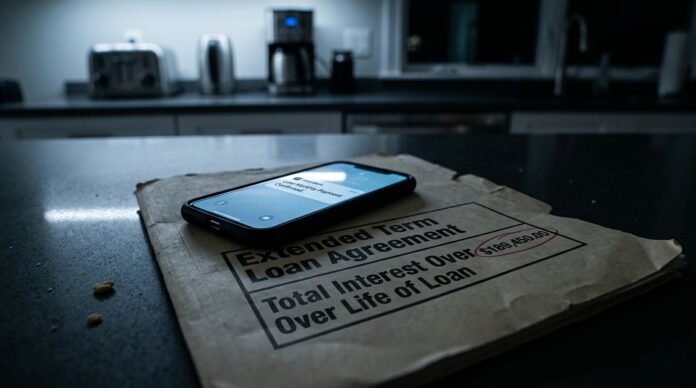
A lower monthly payment can feel like an immediate financial victory.
For a homeowner dealing with credit card balances, a HELOC, a home equity loan or an expensive mortgage, reducing the monthly obligation can create breathing room. There may be more money left for groceries, utilities, insurance, savings and other household expenses.
But there is a problem with focusing too heavily on the monthly payment.
A lower payment does not necessarily mean less debt, lower total costs or a stronger financial position.
Sometimes, a lower monthly payment is achieved by extending the repayment period, refinancing debt over a longer term, transferring unsecured debt onto the home or temporarily reducing the amount required each month.
The household gets immediate relief.
But the underlying debt problem may become larger, last longer or become more closely connected to the property.
This distinction is particularly important for homeowners because housing debt doesn’t exist in isolation. A homeowner may already be dealing with mortgage payments, property taxes, insurance premiums, maintenance, repairs and other costs.
A payment reduction can therefore make a financial problem feel manageable without actually making the household more financially secure.
The Monthly Payment Can Tell Only Part of the Story
Imagine a homeowner has $40,000 of high interest debt.
The current payment is $1,200 per month.
The homeowner consolidates the balance into a new loan and reduces the required payment to $600.
At first glance, the decision appears successful.
The homeowner has freed up $600 every month.
But suppose the new loan stretches the repayment period substantially longer.
The homeowner has not eliminated $40,000 of debt.
The homeowner has changed the speed and structure of repayment.
That may still be worthwhile depending on the interest rate, fees, repayment period and household circumstances.
But the lower payment should not be confused with a lower overall financial obligation.
This is one of the easiest ways for homeowners to misread their financial progress.
Lower Payments Can Come From Stretching the Debt Over More Years
One of the simplest ways to reduce a monthly payment is to extend the repayment period.
The mathematics are straightforward.
If the same balance is spread over more months, each individual payment can become smaller.
But the debt remains outstanding for longer.
And depending on the interest rate and loan structure, the homeowner may pay significantly more interest over the life of the debt.
This creates an important distinction:
Lower monthly cost is not automatically lower total cost.
A homeowner considering refinancing or consolidation should therefore look at both numbers.
Ask:
- How much will I pay each month?
- How many years will I make the payment?
- How much interest will I pay altogether?
- What fees are being added?
- What will the balance be after three, five or ten years?
The monthly payment answers only the first question.
The Danger of Resetting the Mortgage Clock
Mortgage refinancing can make this issue particularly complicated.
Suppose a homeowner has been paying a 30 year mortgage for ten years.
The homeowner refinances and takes out a new 30 year mortgage.
The new payment may be lower because the debt has effectively been spread across another 30 years.
That can improve short term cash flow.
But it can also extend the period during which the homeowner carries mortgage debt.
The result isn’t necessarily bad. Refinancing can make sense for a variety of reasons.
But homeowners should understand what they are trading.
A lower payment today can mean a longer debt obligation tomorrow.
This becomes even more important if the homeowner is refinancing primarily because the household budget is under pressure.
A lower payment may provide necessary relief.
But if the underlying income and expense problem remains, refinancing may only buy time.
Home Equity Can Make the Payment Look Better While Increasing the Stakes
Homeowners have another option that can create an especially important tradeoff: using home equity to consolidate other debt.
Suppose someone has $50,000 in credit card and personal-loan balances.
The homeowner has substantial equity in the property.
A home equity loan or HELOC may reduce the interest rate and lower the required monthly payment.
That can be a legitimate financial strategy.
But the homeowner has also changed the nature of the debt.
Instead of owing unsecured creditors, the household now has debt tied to the property.
This matters because the home has become part of the collateral supporting the financial strategy.
A homeowner should therefore avoid asking only:
“How much lower will my payment be?”
The more important questions include:
“How much will I owe in total?”
“How long will I owe it?”
“What happens if my income falls?”
“What happens if the interest rate changes?”
“Am I putting the home at greater financial risk?”
Those questions provide a much clearer picture.
The Lower Payment Trap Can Start With Good Intentions
Homeowners don’t necessarily fall into this problem because they are careless.
Often, the initial decision is completely understandable.
Maybe insurance premiums increased.
Maybe property taxes went up.
Maybe a major repair depleted savings.
Maybe credit-card debt accumulated after an unexpected expense.
Maybe household income changed.
The homeowner needs to reduce monthly expenses immediately.
A lower payment can provide valuable breathing room.
The problem begins when that short term relief is mistaken for a permanent solution.
If the household continues spending more than it earns, the lower payment may simply create room for another round of borrowing.
Eventually, the homeowner can find themselves with:
- A lower mortgage payment
- A larger or longer-lasting balance
- A HELOC
- New credit card balances
- Rising insurance costs
- Limited emergency savings
The monthly budget may initially look better.
The overall financial position may not be.
When Lower Payments Become a Cash Flow Mask
This is perhaps the biggest warning sign.
A lower payment can mask the difference between a temporary liquidity problem and a structural cash flow problem.
Consider two homeowners.
Homeowner A: Temporary Pressure
A major storm damages the roof.
Insurance covers part of the loss, but the homeowner has a deductible and additional expenses.
The homeowner takes on temporary debt and restructures payments to preserve cash reserves.
Income remains stable.
The debt has a defined payoff plan.
This is primarily a temporary financial challenge.
Homeowner B: Structural Pressure
The homeowner’s normal income is no longer enough to cover:
- Mortgage
- Insurance
- Property taxes
- Utilities
- Maintenance
- Credit card payments
- Household expenses
The homeowner refinances and lowers the monthly payment.
But the household is still spending more than it earns.
New credit-card balances begin accumulating.
This is not simply a payment problem.
It is a structural cash flow problem.
Lowering the payment can make Homeowner B’s situation look better temporarily without solving the underlying issue.
Rising Insurance Costs Make the Problem More Complicated
Homeowners are increasingly required to think about insurance as part of their overall housing budget.
The mortgage payment may remain unchanged while insurance premiums increase.
That can create a deceptive situation.
The homeowner may refinance the mortgage to lower the monthly payment by $300.
But if insurance costs rise by $150, property taxes increase by $100, and maintenance costs continue climbing, much of the apparent savings disappears.
The mortgage payment is lower.
The total cost of owning the home may not be.
This is why homeowners should evaluate total housing costs, rather than treating the mortgage payment as the complete price of ownership.
A realistic housing budget may include:
Mortgage + insurance + property taxes + maintenance + utilities + repairs + assessments.
A lower mortgage payment does not automatically make the entire property more affordable.
The “Minimum Payment” Problem
Credit cards offer another example of why monthly payments can be misleading.
A minimum payment can keep an account current while allowing the balance to remain outstanding for a long time.
The payment is manageable.
The debt is not necessarily being eliminated quickly.
The same psychological effect can occur with other forms of borrowing.
When a payment is small relative to household income, the debt may feel harmless.
But multiple small payments can accumulate.
A homeowner may have:
- $350 for a credit card
- $300 for a personal loan
- $250 for a HELOC
- $200 for another financing account
Each payment individually appears manageable.
Together, they represent $1,100 every month.
This is why homeowners should look at the total debt service burden, not just whether each individual payment fits the budget.
A Longer Loan Can Change the Meaning of “Affordable”
There is an important difference between something being affordable this month and being affordable over the entire repayment period.
A lower payment can make a loan fit today’s budget.
But homeowners should also consider:
- Future income
- Retirement plans
- Potential insurance increases
- Property tax changes
- Maintenance requirements
- Interest rate changes
- Other debt
- Emergency expenses
A homeowner nearing retirement, for example, may care more about how much debt remains five or ten years from now than simply how much the payment falls today.
The same applies to homeowners whose income is uncertain.
A payment structure that looks comfortable under today’s conditions may become difficult if circumstances change.
The Home Can Become the Household’s Financial Shock Absorber
There is another risk when homeowners repeatedly use refinancing and home equity to reduce monthly financial pressure.
The house can gradually become the family’s financial shock absorber.
Every time expenses increase, equity gets tapped.
Every time debt becomes expensive, it gets consolidated.
Every time the budget becomes tight, the mortgage gets refinanced.
The strategy can work for a while because the property has substantial value.
But equity is finite.
And borrowing against it reduces the cushion that once provided financial security.
This can eventually produce an uncomfortable contradiction:
The homeowner has a valuable house but increasingly little unencumbered equity.
The property still has a high market value.
But more of that value is supporting debt.
Falling Home Values Can Expose the Problem
A homeowner who relies heavily on property appreciation to support borrowing is vulnerable to a change in housing conditions.
Consider a hypothetical property worth $700,000.
The homeowner owes:
- $200,000 on the mortgage
- $75,000 on a HELOC
- $25,000 in other home secured borrowing
Total secured debt is $300,000.
The homeowner has approximately $400,000 in equity before transaction costs.
If the property falls to $600,000, the debt does not automatically fall with it.
The equity position becomes approximately $300,000.
That is still substantial.
But the margin of safety has declined.
The more debt homeowners attach to a property, the more important the property’s value becomes to the household’s overall financial position.
This is another reason not to treat today’s equity balance as permanently available spending power.
Lower Payments Can Encourage More Borrowing
There is also a behavioral dimension.
When debt payments fall, homeowners may feel as though they have created extra income.
That can be dangerous.
Suppose refinancing frees up $500 every month.
If the household immediately absorbs that $500 through higher spending, the financial benefit disappears.
The homeowner has lower debt payments but no greater financial resilience.
Ideally, payment savings should strengthen the household.
That might mean directing the difference toward:
- Emergency savings
- Faster debt repayment
- Retirement contributions
- Necessary home repairs
- Insurance reserves
- Other financial priorities
Otherwise, the homeowner may simply increase consumption while maintaining a large debt balance.
The Real Problem May Be the Cost of the House
Sometimes a homeowner keeps searching for ways to lower the mortgage payment when the larger problem is the overall cost of the property.
That can happen when:
- Insurance becomes expensive
- Property taxes rise
- Repairs become frequent
- The home is larger than the household needs
- Utilities are increasingly expensive
- The homeowner’s income has declined
- Retirement is approaching
- Debt has accumulated around the property
At that point, reducing the mortgage payment may not be enough.
The homeowner may need to ask a more difficult question:
Is this house still financially sustainable for my household?
That does not automatically mean selling is the right decision.
But it does mean homeowners should evaluate the complete cost of ownership rather than endlessly restructuring the mortgage.
A Paid Off Home Can Still Have a Debt Problem
The same principle applies to homeowners with little or no mortgage debt.
A homeowner may own the property outright and still borrow against it repeatedly.
For example, someone could have a fully paid off $500,000 home but use:
- A $50,000 HELOC for renovations
- Another $20,000 for debt consolidation
- Another $10,000 for unexpected expenses
The homeowner technically has no mortgage.
But the property is no longer entirely debt free.
This is why the phrase “I own my house outright” does not tell the whole financial story.
The relevant question is how much debt is secured by the property and whether the household can comfortably service it.
What Homeowners Should Compare Before Accepting a Lower Payment
Before refinancing, consolidating debt or taking out home equity, homeowners should compare more than the proposed monthly payment.
1. Current Balance
How much debt remains today?
2. New Balance
Will fees, closing costs or additional borrowing increase the principal?
3. Interest Rate
Is the rate fixed or variable?
4. Loan Term
How many additional years will the homeowner be making payments?
5. Total Interest
How much interest will be paid if the debt remains outstanding for the full term?
6. Equity Impact
How much home equity will remain after the transaction?
7. Cash Flow Benefit
How much money will actually be freed each month?
8. Future Housing Costs
Can the household absorb increases in insurance, taxes, maintenance and utilities?
9. Emergency Reserves
Will the homeowner still have enough accessible savings after the transaction?
10. Debt Cause Analysis
What caused the original debt and has that problem actually been addressed?
These questions can reveal whether the lower payment represents genuine improvement or simply a longer repayment timeline.
Watch the Difference Between Payment Relief and Debt Relief
These terms may sound similar, but they are not.
Payment relief means the household has to pay less each month.
Debt relief means the underlying debt burden is actually reduced or eliminated.
A homeowner can receive payment relief without receiving meaningful debt relief.
For example, refinancing a $200,000 balance into a longer term loan may reduce the monthly payment while leaving the homeowner with substantial debt for many additional years.
Similarly, transferring credit card debt to a home equity loan may reduce the interest rate but still leave the principal unchanged.
The homeowner has improved the financing structure.
The debt itself remains.
That distinction should be at the center of any consolidation decision.
The Best Use of a Lower Payment Is to Build Financial Strength
A lower monthly payment can be valuable.
The key is what the homeowner does with the money that has been freed up.
If the savings are used to rebuild emergency funds, eliminate other debt, maintain adequate insurance or accelerate repayment, the household may become more resilient.
If the savings simply create room for additional spending, the homeowner may not actually improve their financial position.
This is particularly important after a debt consolidation transaction.
The lower payment should ideally become part of a broader financial plan rather than an invitation to take on more debt.
When a Lower Payment Should Make You More Cautious
A lower payment deserves extra scrutiny when:
- The repayment term becomes much longer
- The total interest cost rises
- Closing costs are significant
- A variable rate product is involved
- Home equity is being used to consolidate unsecured debt
- Emergency savings are already low
- The household has recurring cash flow deficits
- Credit cards will remain available for new borrowing
- Insurance and property costs are rising
- The homeowner expects income to decline
- The strategy depends on future home appreciation
These factors do not automatically make refinancing or consolidation inappropriate.
They simply mean the homeowner should look beyond the monthly payment.
A Lower Payment Should Solve a Problem, Not Hide One
The most useful way to think about payment reduction is to ask what problem it is solving.
If the problem is a temporary mismatch between income and expenses, a lower payment may provide valuable breathing room.
If the problem is an expensive loan, restructuring may reduce the cost of borrowing.
But if the problem is that the household consistently cannot afford its lifestyle, home or existing debt load, reducing payments may only delay the necessary financial adjustment.
That is when the strategy can become dangerous.
A homeowner may spend years refinancing, consolidating and borrowing against equity without ever addressing the underlying imbalance.
A lower monthly payment can be genuinely helpful.
But homeowners should never treat a lower payment as proof that their debt problem has been solved.
The payment could be lower because:
- The loan lasts longer
- The balance has been restructured
- Debt has been moved to a different account
- Home equity has been converted into borrowing
- Interest has been spread across more years
- A temporary payment arrangement is being used
Each of those situations requires a different analysis.
For homeowners, the stakes can be particularly high because some debt reduction strategies involve the home itself.
A lower payment may improve today’s cash flow while increasing the amount of time the household remains indebted or putting more equity behind the debt.
The better question is not:
“How much will my monthly payment fall?”
It is:
“Will this decision reduce my overall financial burden and make my household more resilient over time?”
That means looking at total interest, repayment length, home equity, insurance, property taxes, maintenance, emergency savings, income stability and the reason the debt accumulated in the first place.
Because financial health is not measured by how small a payment can become.
It is measured by whether the household can comfortably meet its obligations, protect its home, absorb unexpected costs, and reduce debt without repeatedly borrowing again.
A lower payment can create breathing room.
The goal should be to make sure that breathing room becomes financial progress rather than another way to postpone the problem.