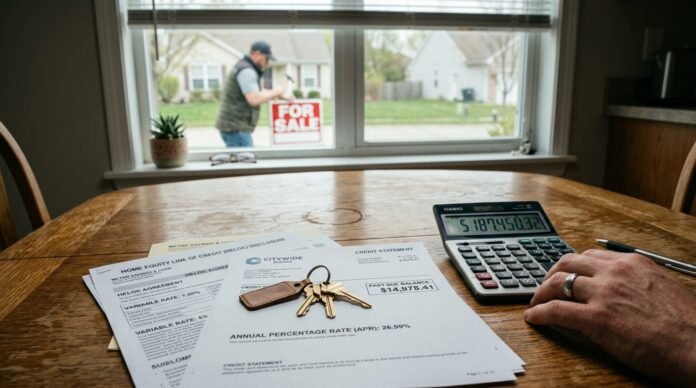
For homeowners facing rising expenses, a home equity line of credit can look like an attractive solution.
The house has appreciated. There is substantial equity. The HELOC provides access to cash without selling the property. And unlike a traditional loan, homeowners generally don’t have to borrow the entire available amount at once.
That flexibility can be useful.
But it can also make a potentially dangerous financial decision feel easier than it really is.
Using home equity to cover a major, one time expense may be reasonable under the right circumstances. Using a HELOC repeatedly to pay for ordinary homeownership costs is a different situation.
At some point, borrowing against the house stops being a temporary financial tool and starts becoming a way of subsidizing an unaffordable household budget.
That is where the warning signs begin.
A HELOC Doesn’t Make Homeownership Costs Disappear
One of the biggest problems with using a HELOC for ongoing expenses is that it can create the illusion that the underlying problem has been solved.
Suppose a homeowner is struggling with:
- Higher homeowners insurance premiums
- Increasing property taxes
- Maintenance expenses
- Utility bills
- Regular repairs
- Other household costs
The homeowner could draw $10,000 from a HELOC and pay those bills.
The immediate problem is solved.
But the expenses haven’t disappeared.
The homeowner has simply moved some of today’s costs into tomorrow’s debt payments.
That can be reasonable when the expense is temporary and the homeowner has a clear plan to repay the borrowing.
It becomes much more concerning when the same strategy is repeated year after year.
The Key Question Is Why You Need the Money
Before using home equity, homeowners should ask a deceptively simple question:
What exactly am I borrowing this money for?
There is a significant difference between borrowing $25,000 to replace a failing roof and borrowing $25,000 because the household’s normal expenses consistently exceed its income.
The first may be a financing decision.
The second may be a cash flow problem.
A HELOC can potentially help with the first.
It may make the second problem worse.
This distinction should be at the center of any homeowner’s decision to tap equity.
One Time Costs Are Different From Permanent Costs
This may be the most important distinction of all.
Some homeownership expenses are occasional.
A roof might need replacing once every couple of decades. An HVAC system may eventually fail. A major plumbing problem may require an expensive repair.
These expenses can be financially painful, but they are not necessarily permanent.
Other expenses are recurring.
Insurance premiums.
Property taxes.
Utilities.
Routine maintenance.
Regular household spending.
If a homeowner needs to borrow repeatedly to cover recurring costs, the issue isn’t simply that the homeowner needs access to more money.
The issue may be that the cost of maintaining the property has become too high relative to household income and savings.
Using debt to bridge that gap indefinitely is risky.
A HELOC Can Turn Home Equity Into a Financial Crutch
Homeowners with substantial equity can sometimes become overly comfortable with borrowing.
They know the house is valuable.
They know a lender may be willing to provide a large credit line.
And because the money is secured by the property, the interest rate may appear more attractive than unsecured alternatives.
That can make the HELOC feel like an unusually convenient source of money.
But convenience can become a problem.
If homeowners begin thinking:
“If I need money, I can always borrow against the house.”
they may become less motivated to maintain cash reserves, reduce expenses or address the underlying source of financial pressure.
The home effectively becomes a revolving financial account.
That’s a dangerous mindset.
Your Home Is the Collateral
A HELOC isn’t just another credit card.
It is secured by your home.
That changes the risk.
If the debt becomes unmanageable, the consequences can be much more serious than simply having another outstanding balance.
Homeowners therefore need to distinguish between using home equity strategically and using home equity because they have run out of other options.
The second situation deserves considerably more caution.
Rising Insurance Costs Can Make This Problem Worse
Insurance is particularly interesting because it can create a recurring expense that homeowners have little control over.
A homeowner may have purchased a property when the insurance premium was manageable.
Several years later, the premium could be considerably higher.
If the homeowner’s income hasn’t increased at the same pace, the additional cost has to come from somewhere.
Some households may respond by reducing discretionary spending.
Others may reduce savings.
Some may take on credit card debt.
And some may turn to home equity.
A HELOC can provide temporary relief from an insurance related cash flow problem.
But it doesn’t change the fact that the insurance bill will likely return.
That makes borrowing to pay recurring insurance expenses particularly important to scrutinize.
Borrowing to Pay Insurance Is Not Necessarily Wrong But It Can Be a Warning Sign
There are circumstances in which using a HELOC for an insurance related expense could be reasonable.
For example, a homeowner might face a temporary cash flow disruption and need to bridge a short term gap.
But if the homeowner needs to draw on the HELOC every year to pay the premium, the strategy deserves much more scrutiny.
The question becomes:
What happens when the insurance bill increases again?
If the answer is “borrow more,” the household may be entering a cycle.
The HELOC balance grows.
Interest accumulates.
Available equity declines.
And future financial flexibility becomes increasingly dependent on the value of the home and the homeowner’s ability to continue borrowing.
The Variable Rate Problem
Another consideration is that many HELOCs have variable interest rates.
That means the cost of carrying the balance can change over time.
A homeowner who calculates affordability based on today’s payment could discover that the cost of the debt increases later.
This creates an additional layer of uncertainty when HELOC funds are being used for expenses that themselves may continue rising.
Imagine a homeowner borrowing against the property to absorb higher annual expenses.
If the HELOC rate subsequently rises, the homeowner could face two pressures simultaneously:
Higher household costs + higher debt costs.
That is precisely the combination a homeowner should try to avoid.
The Minimum Payment Can Be Deceptively Comfortable
Another potential problem is focusing too heavily on the required monthly payment.
A relatively small minimum payment can make a large balance feel manageable.
But homeowners should consider the entire cost of the borrowing, including:
- Interest
- Repayment terms
- Rate changes
- Fees
- How long the balance will remain outstanding
- Whether the payment could increase
- What happens when the repayment period begins
A payment that looks comfortable today doesn’t necessarily mean the borrowing is inexpensive.
The longer the balance remains outstanding, the more important the total cost becomes.
The Danger of Paying One Homeownership Expense With Another
There is a subtle financial trap that can develop when homeowners repeatedly use equity to handle property costs.
The homeowner may begin with a legitimate repair.
Then comes an insurance increase.
Then property taxes rise.
Then another repair appears.
Each individual borrowing decision may seem defensible.
But together, they can create a larger problem.
The homeowner is effectively using debt to maintain an asset that requires increasingly large amounts of money to operate.
At some point, the homeowner needs to ask:
Is the property still financially sustainable?
That question can be uncomfortable, particularly when the homeowner has strong emotional ties to the house.
But it can be more important than the question of whether another HELOC draw is available.
When the Home Is Valuable but the Cash Flow Doesn’t Work
This is where homeowners can become particularly vulnerable.
A property may be worth $700,000.
The homeowner might owe very little or nothing on the mortgage.
That can create substantial borrowing capacity.
But suppose the household has limited income and increasingly expensive insurance, taxes and maintenance.
The homeowner may be equity rich but cash flow poor.
A HELOC can make that situation look sustainable for a while.
The homeowner can use the equity to bridge gaps.
But borrowing capacity isn’t the same thing as income.
Eventually, the debt must be repaid.
A HELOC Shouldn’t Be Used to Preserve an Unsustainable Lifestyle
There is another distinction worth making.
Homeownership costs aren’t limited to the house itself.
Some households may use home equity to avoid making difficult lifestyle adjustments.
For example, they might continue spending at the same level while using the HELOC to cover the growing gap.
That can be especially dangerous because the borrowing isn’t funding an asset improvement or temporary disruption.
It’s funding consumption.
When the borrowed money is gone, the underlying spending problem remains.
A HELOC should not become a substitute for making difficult financial decisions.
The “I’ll Pay It Back Later” Problem
Home equity borrowing can also encourage future-income optimism.
A homeowner may think:
“I’ll pay this off when I get my bonus.”
Or:
“I’ll repay it after my next raise.”
Or:
“The house will keep appreciating, so I’ll have plenty of equity.”
These assumptions may turn out to be correct.
But financial planning becomes fragile when repayment depends on events that haven’t happened yet.
A stronger borrowing decision is one where the repayment plan works using income and resources the homeowner can reasonably expect, not an optimistic future scenario.
When Using a HELOC May Be More Defensible
Using a HELOC isn’t inherently a bad idea.
There are circumstances in which it can be a useful financial tool.
It may make more sense when:
- The expense is substantial and unavoidable.
- The borrowing is for a defined purpose.
- The homeowner has sufficient income to repay the balance.
- The homeowner maintains an emergency fund.
- The debt won’t overwhelm the household budget.
- The homeowner understands the variable rate risk.
- There is a realistic repayment timeline.
- The expense isn’t simply replacing a permanent income shortfall.
For example, a major home repair that protects the property may be fundamentally different from borrowing every year to cover routine household bills.
When a HELOC Starts Looking Like a Bad Idea
The warning signs become stronger when:
1. You’re borrowing for recurring bills
If the same expenses require borrowing repeatedly, the household may have a structural cash-flow problem.
2. You’re using the HELOC to fund everyday spending
This can transform home equity into a source of consumer debt.
3. You have little emergency savings
If the HELOC becomes your emergency fund, you’re relying on additional debt to protect yourself from future debt.
4. You already have significant debt
Adding a secured loan to an already stretched balance sheet can increase overall risk.
5. You can’t explain how you’ll repay it
If the repayment plan is essentially “I’ll figure it out later,” the borrowing may be premature.
6. The property itself is becoming unaffordable
If insurance, taxes and maintenance consistently exceed what the household can comfortably support, borrowing may only delay a larger decision.
7. You’re relying on future home appreciation
A rising property value isn’t guaranteed.
Using today’s equity based on an assumption that the home will be worth significantly more tomorrow can create unnecessary risk.
Don’t Confuse Available Equity With Available Income
This may be the most important mindset shift for homeowners.
Home equity is an asset.
Income is cash flow.
They serve different purposes.
A homeowner can have hundreds of thousands of dollars in equity and still struggle to cover recurring expenses.
A HELOC converts some of that equity into debt.
It does not create new income.
That’s why homeowners should be careful about using borrowing capacity to compensate for an income problem.
What About Using a HELOC for Home Improvements?
This situation deserves its own consideration.
Borrowing for renovations can sometimes be reasonable if the project is necessary, carefully budgeted and financially sustainable.
But homeowners should avoid assuming that every renovation will increase the home’s value by enough to justify the debt.
A $50,000 renovation isn’t automatically a $50,000 increase in property value.
And even if the home’s value rises, the homeowner still has to make the payments.
The project should therefore be evaluated based on its purpose, cost, expected benefit and impact on the household’s overall finances.
A Better Way to Evaluate the Decision
Before drawing from a HELOC, homeowners can walk through five questions.
First: Is this expense temporary or recurring?
If it will happen again next year, borrowing deserves additional scrutiny.
Second: What is the total cost of the borrowing?
Don’t focus solely on today’s payment.
Third: What happens if the interest rate rises?
A variable rate balance can become more expensive.
Fourth: What happens if home values decline?
A homeowner shouldn’t build a financial plan that depends on perpetual property appreciation.
Fifth: Can the household repay the debt without another round of borrowing?
If not, the cycle may already be forming.
The Bigger Risk Is Not the First HELOC Draw
One HELOC draw doesn’t necessarily create a financial crisis.
The bigger risk is the pattern that can follow.
Borrow.
Repay partially.
Borrow again.
Use equity for another expense.
Increase the balance.
Repeat.
Eventually, the homeowner may have a substantial debt balance secured by the property without having created any new income or productive asset.
That’s when home equity stops functioning primarily as wealth and starts functioning as a revolving source of debt.
Sometimes the Harder Question Is Whether to Keep the Property
This is an uncomfortable possibility, but it belongs in the conversation.
If a homeowner consistently needs to borrow to afford insurance, taxes, maintenance and other unavoidable costs, the issue may not be financing.
The property itself may no longer fit the household’s financial circumstances.
Selling, downsizing or moving to a lower cost property can be emotionally difficult.
But continuously borrowing against the home can also have long term consequences.
The goal of financial planning should not be to preserve a particular property at any cost.
It should be to maintain a sustainable financial life.
A HELOC can be a valuable financial tool for homeowners.
It can provide access to capital for major repairs, renovations or other carefully considered expenses.
But the line between strategic borrowing and financial dependence on home equity can become surprisingly thin.
The biggest warning sign isn’t necessarily the size of the HELOC.
It’s the reason you’re using it.
If you’re borrowing for a one time expense with a realistic repayment plan, the strategy may be manageable.
If you’re repeatedly borrowing to cover insurance, taxes, maintenance or ordinary household expenses, the HELOC may be masking a deeper affordability problem.
And that’s when homeowners need to stop asking:
“How much equity can I access?”
and start asking:
“Why do I need to borrow against my house to afford this in the first place?”
Home equity can provide financial flexibility, but it shouldn’t become the mechanism that keeps an otherwise unsustainable homeownership situation afloat.
The smartest use of a HELOC isn’t simply the one that gets you through today’s bill. It’s the one that doesn’t create a bigger financial problem tomorrow.