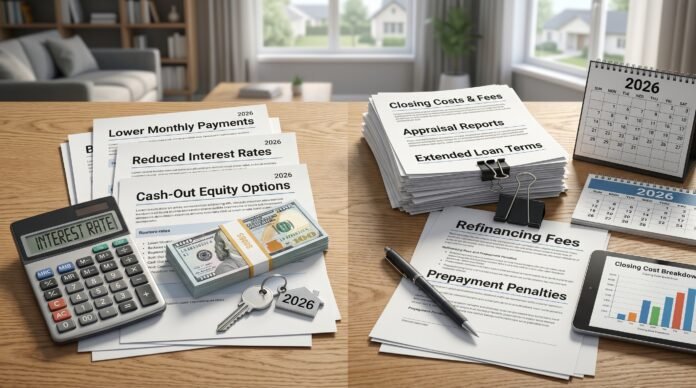
Refinancing in 2026 isn’t the obvious win it used to be.
Rates are higher than the historic lows many homeowners locked in, but they’re also stabilizing. That puts refinancing in a gray area where it can either save you money or quietly cost you more.
Here’s a clear, practical breakdown of the pros and cons so you can decide based on your situation.
The Pros of Refinancing in 2026
1. You Could Lower Your Interest Rate (In Some Cases)
If your current mortgage rate is higher than today’s market rates, refinancing can:
- Reduce your monthly payment
- Lower total interest over time
This is especially relevant for homeowners who took loans during higher-rate periods.
2. You Can Switch to a Fixed Rate
If you currently have an adjustable rate mortgage (ARM), refinancing into a fixed rate loan gives you:
- Predictable monthly payments
- Protection from future rate increases
In a market with ongoing uncertainty, stability has real value.
3. You May Be Able to Remove PMI
If your home has increased in value and you now have 20%+ equity, refinancing can eliminate private mortgage insurance (PMI).
That’s a direct reduction in your monthly costs without changing your lifestyle.
4. You Can Restructure Your Loan Term
Refinancing allows you to:
- Shorten your loan (e.g., 30-year → 15-year)
- Build equity faster
- Reduce total interest paid
Or extend the term to reduce monthly payments if cash flow is tight.
5. Access to Home Equity
A cash out refinance lets you tap into your home’s equity for:
- Renovations
- Debt consolidation
- Large expenses
Compared to credit cards, mortgage based borrowing often carries lower rates.
The Cons of Refinancing in 2026
1. You May Lose a Low Existing Rate
This is the biggest drawback right now.
If you locked in a 2% – 4% mortgage, refinancing into today’s ~6% range can:
- Increase your monthly payment
- Raise your long term interest cost
For many homeowners, this alone makes refinancing a poor move.
2. Closing Costs Can Be Significant
Refinancing typically costs 2% – 5% of your loan amount.
That includes:
- Origination fees
- Appraisal
- Title costs
If you don’t stay in the home long enough to recover these costs, refinancing doesn’t pay off.
3. You Might Extend Your Loan Timeline
Resetting to a new 30-year mortgage can:
- Add years to your repayment
- Increase total interest paid
Even if your monthly payment drops, your long term cost might rise.
4. Cash Out Refinancing Increases Debt
Accessing equity sounds helpful, but it:
- Raises your loan balance
- Increases total interest exposure
- Puts more of your home at risk
It’s useful when strategic, risky when used casually.
5. Market Uncertainty Still Exists
Rates in 2026 are stabilizing, but not fully predictable.
There’s still:
- Inflation pressure
- Economic uncertainty
- Potential rate fluctuations
Refinancing today doesn’t guarantee you’re getting the best possible rate long term.
When Refinancing Makes Sense Right Now
It’s usually a smart move if:
- Your current rate is higher than market rates
- You’re improving your loan structure (not just reacting)
- You plan to stay long enough to break even
- You’re removing PMI or stabilizing payments
When It Doesn’t Make Sense
Be cautious if:
- You already have a low fixed rate
- You’re refinancing mainly for short term relief
- Closing costs outweigh potential savings
- You’re extending debt without a clear plan
Quick Reality Check
Before refinancing, ask:
- Will this reduce my total interest paid?
- Am I improving my long term financial position?
- How long until I break even?
- Am I solving a real problem or just reacting?
If the answers are clear and positive, refinancing can work.
If not, it’s worth waiting or exploring alternatives.
Refinancing in 2026 is no longer automatic. It’s strategic.
The pros are real lower rates (in some cases), better structure, access to equity.
The cons are just as real higher rates for many borrowers, upfront costs and potential long-term increases in debt.
The right decision depends on your numbers, not the market headlines.