
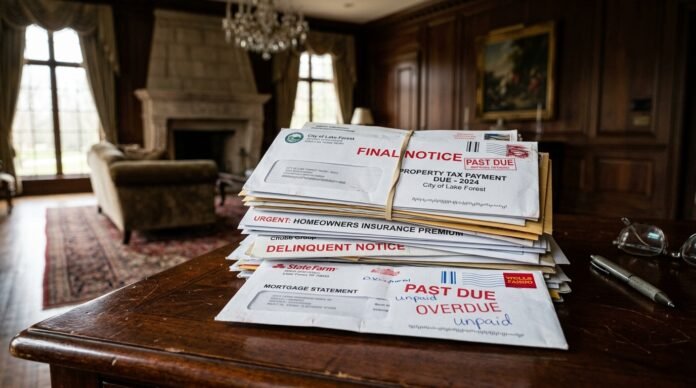
For years, homeowners have been encouraged to think of rising home values as one of the clearest signs of financial progress.
A house purchased for $300,000 that is now worth $500,000 appears to tell a simple story: the homeowner has built $200,000 in wealth.
On paper, that may be true.
But there is a growing financial distinction that homeowners cannot afford to ignore: having substantial home equity does not necessarily mean having a financially comfortable household.
A homeowner can have hundreds of thousands of dollars tied up in a property while simultaneously struggling to pay insurance premiums, property taxes, maintenance bills, utilities, repairs or other household expenses.
That is where the home equity trap begins.
The house becomes more valuable, but the money required to keep owning it also rises. The homeowner may become wealthier on paper while becoming less flexible in everyday financial life.
In some cases, that can lead to a particularly complicated situation: borrowing against the same asset that is supposed to represent financial security.
A HELOC, home equity loan, or cash out refinance can turn some of that equity into usable cash. But accessing equity through debt does not eliminate the underlying affordability problem. It simply converts part of the homeowner’s wealth into a new financial obligation.
The result can be a home that looks like an asset from the outside but increasingly behaves like a financial burden.
Home Equity Is Wealth, But It Isn’t Cash Flow
The first mistake homeowners can make is confusing net worth with liquidity.
Suppose a homeowner owns a property worth $650,000 and owes only $100,000 on the mortgage.
That creates approximately $550,000 in home equity before considering selling costs and other factors.
It sounds financially strong.
But imagine the same homeowner has only $15,000 in savings and faces $8,000 in annual property taxes, $4,500 in homeowners insurance and several thousand dollars in maintenance and repair expenses.
The homeowner may have significant wealth but limited financial flexibility.
That distinction matters because most homeownership expenses have to be paid with actual cash.
Insurance companies do not accept home equity as payment for an annual premium. Property tax authorities generally do not accept appreciation in the value of the house as payment either. A roof replacement still requires money. Plumbing repairs still require money. Utility bills still arrive.
The value of the property can increase without putting another dollar into the homeowner’s checking account.
This creates what can be called an equity liquidity mismatch.
The homeowner owns something valuable but may not have enough accessible cash to comfortably maintain it.
The More Valuable the Home Becomes, the More Complicated the Problem Can Get
Home appreciation is generally viewed as positive because it increases household wealth.
But appreciation does not automatically reduce the cost of owning the property.
A more expensive home may require higher insurance coverage limits. Property taxes may rise depending on local rules and assessments. Larger or older homes can require more expensive repairs. Construction and labor costs can make maintenance increasingly expensive.
Insurance is particularly important because homeowners cannot simply look at the property’s market value when deciding whether the home remains affordable.
They also have to consider the cost and availability of adequate coverage.
A house may have appreciated substantially while its insurance premium has also increased.
That can produce a strange financial outcome.
The homeowner says:
“My house is worth much more than when I bought it.”
But the household budget says:
“Keeping this house is becoming more expensive.”
Both statements can be true at the same time.
That is why home value alone is an incomplete measure of financial security.
When Equity Starts Masking a Cash Flow Problem
One of the most dangerous aspects of substantial home equity is that it can make a financial problem appear temporary.
A homeowner with little equity and limited savings may immediately recognize that a monthly budget is unsustainable.
A homeowner with $300,000 or $500,000 of equity may think differently.
They may reason that there is always an option available:
- Open a HELOC.
- Take a home equity loan.
- Refinance.
- Sell later.
- Borrow temporarily.
- Wait for the property to appreciate further.
Those options can provide flexibility under the right circumstances.
But they can also delay recognition of a more fundamental problem.
If a homeowner repeatedly needs to borrow against the house to pay ordinary ownership expenses, the issue may no longer be a temporary liquidity shortage.
It may be an affordability problem.
That distinction is critical.
Borrowing $20,000 for an unexpected structural repair is fundamentally different from borrowing $20,000 every year because the household cannot consistently cover its normal expenses.
The first may be an unusual financial event.
The second suggests the household’s recurring cash flow is not keeping pace with the cost of ownership.
The HELOC Can Make Equity Feel More Liquid Than It Really Is
A HELOC can change the psychological relationship homeowners have with their equity.
Instead of viewing home equity as wealth that is relatively difficult to access, a homeowner may begin viewing it as a large available balance.
That can make borrowing feel less consequential.
A homeowner might think:
“I have $400,000 in equity, so using $15,000 isn’t a big deal.”
But the relevant question is not simply how much equity exists.
The more important questions are:
- Why is the money needed?
- How frequently will it be needed?
- What interest rate applies?
- How quickly can the balance be repaid?
- What happens if rates rise?
- Will the homeowner still have adequate emergency savings?
- Is the property still affordable without additional borrowing?
A large equity cushion can make a debt balance look small relative to the value of the property.
But the debt still creates a payment obligation.
And because home equity borrowing is secured by the property, repeatedly increasing the balance can change the homeowner’s risk profile.
The Home Equity Trap Often Starts With Reasonable Decisions
The trap does not necessarily begin with reckless borrowing.
It can develop gradually.
Consider a homeowner who has owned a house for 15 years.
The property has appreciated significantly. The mortgage balance is relatively small. The homeowner feels financially secure.
Then several expenses arrive over a few years:
A new roof.
Higher insurance premiums.
A major HVAC replacement.
Higher property taxes.
Unexpected plumbing work.
Perhaps credit card balances accumulated during a period of higher household expenses.
The homeowner has equity, so they use some of it.
At first, the decision may make sense.
But then another expense appears.
The homeowner borrows again.
Eventually, the household may reach a point where the house has substantial equity but also several new financial obligations.
The homeowner has not necessarily become irresponsible.
The problem is that the house has gradually become the household’s financial shock absorber.
That is where the strategy can become dangerous.
Using Home Equity to Cover Insurance Deserves Particular Attention
Insurance costs deserve special consideration because they are not normally optional in the same way that discretionary spending can be.
Mortgage lenders generally require homeowners insurance while a mortgage is outstanding. Even after the mortgage is paid off, going without appropriate coverage can expose the homeowner to potentially devastating losses.
That creates a difficult situation when premiums rise sharply.
A homeowner may be tempted to put an annual insurance bill on a credit card, use savings, or draw from a HELOC.
The immediate problem gets solved.
But the next premium still arrives.
If the homeowner has to borrow again to pay it, the financing strategy is no longer addressing a one-time emergency.
It is financing a recurring ownership expense.
That should be treated as a warning sign.
A homeowner should not assume that because equity is available, borrowing against it is automatically an appropriate solution to rising insurance costs.
The underlying question is whether the household can sustainably afford the property.
The “House Rich, Cash Poor” Problem
The phrase “house rich, cash poor” describes a situation in which a homeowner has significant wealth in real estate but relatively little liquid money.
It can affect homeowners at different stages of life.
Younger homeowners may experience it after aggressively investing in a property while keeping limited cash reserves.
Middle aged homeowners may encounter it after years of appreciation and rising household expenses.
Older homeowners may face it after paying down their mortgage while living on a fixed or relatively predictable income.
The common problem is the same:
The asset is valuable, but the asset does not automatically produce the cash needed to maintain it.
This becomes especially important when income falls.
A homeowner who is working full time may be able to handle a $1,500 monthly ownership increase.
Someone approaching retirement may not have the same flexibility.
The property may have appreciated dramatically, but the homeowner cannot spend that appreciation without selling, borrowing or otherwise accessing the equity.
Selling the House Can Be Emotionally and Financially Difficult
When a valuable property becomes too expensive to maintain, selling may appear to be the obvious solution.
But it is rarely that simple.
The home may have sentimental value.
The homeowner may have lived there for decades.
Moving could mean leaving family, friends, schools, neighbors or a community.
There are also financial considerations.
Selling involves transaction costs and may require finding another place to live. A cheaper property may not be available in the same neighborhood. Renting may introduce a different set of expenses and uncertainties.
As a result, homeowners can become trapped between two competing realities.
They have enough equity to appear financially secure.
But they do not have enough cash flow to comfortably maintain the property.
That is one reason why equity should not be viewed as the same thing as financial independence.
The Biggest Warning Sign Is Repeated Borrowing
There is an important difference between using equity strategically and using equity repeatedly to keep the household functioning.
A homeowner may reasonably borrow against a property for a major improvement, a necessary repair or another carefully evaluated expense.
The problem develops when borrowing becomes routine.
Warning signs can include:
- Repeated HELOC withdrawals for ordinary bills
- Borrowing to pay insurance premiums year after year
- Using home equity to cover property taxes
- Increasing debt while income remains stagnant
- Having substantial equity but very little emergency savings
- Using one form of debt to pay another
- Assuming future home appreciation will solve today’s debt
- Taking equity out without a clear repayment strategy
- Continuing to borrow despite persistent monthly cash flow deficits
- Treating available equity as part of normal monthly income
None of these automatically means a homeowner has made a bad decision.
But together, they can indicate that the household is relying too heavily on the property to compensate for weak cash flow.
Rising Home Values Can Create a False Sense of Security
There is another psychological risk.
When homeowners see their property value rising, they may feel financially safer even if their monthly budget is becoming tighter.
A homeowner might have purchased a property for $250,000 that is now worth $600,000.
That $350,000 increase can feel like a massive financial cushion.But if insurance, taxes, maintenance, utilities and other ownership expenses have also increased substantially, the homeowner may actually have less disposable income than expected.
The appreciation is real.
So is the cash flow pressure.
This is why homeowners should be careful about using rising property values as justification for taking on more debt.
Future appreciation is not guaranteed.
Housing markets can stagnate or decline, while debt payments remain.
A homeowner who borrows heavily against a property during a period of high valuations may discover that the equity cushion is much smaller if prices subsequently fall.
What Happens When Property Values Decline?
The home equity strategy becomes particularly vulnerable when property values fall.
Imagine a homeowner with:
- $600,000 property value
- $100,000 existing mortgage
- $50,000 HELOC balance
The homeowner has approximately $450,000 in equity before transaction costs.
Now imagine the property value falls to $500,000.
The homeowner still owes approximately $150,000.
The equity cushion has fallen to roughly $350,000.
The debt did not fall simply because the property became less valuable.
This matters because homeowners sometimes make financial decisions based on today’s equity balance without considering how quickly that balance can change.
The more debt attached to the property, the more important the margin of safety becomes.
A Valuable House Can Still Be the Wrong House for the Household Budget
This is one of the hardest realities for homeowners to accept.
A house can be a great investment and still be a poor fit for the household’s current cash flow.
The property may have appreciated.
The mortgage may be nearly paid off.
The neighborhood may be desirable.
The homeowner may have substantial net worth.
And yet the cost of keeping the property may be consuming too much income.
Financial decisions should account for the ongoing cost of ownership, not just the amount of equity accumulated.
That means looking beyond the mortgage payment.
A homeowner’s true housing budget can include:
Mortgage + insurance + property taxes + maintenance + utilities + repairs + assessments + planned improvements.
For some households, those costs can become substantial even after the mortgage balance is relatively small.
The Real Question Is Not “How Much Equity Do I Have?”
Homeowners often focus on one number:
How much equity do I have?
A more useful financial analysis asks several questions.
How much does it cost to keep the property?
Calculate the recurring annual cost of ownership, including insurance, taxes, utilities, maintenance and a realistic repair reserve.
How much cash is actually available?
Equity is not the same as an emergency fund.
A household should know how many months of essential expenses could be covered without borrowing.
How often am I borrowing?
One large, unusual expense is different from repeated withdrawals.
Could I afford the property without accessing equity?
This may be the most revealing question of all.
If the answer is no, the homeowner needs to understand why.
What happens if property values stop rising?
A sustainable financial plan should not depend entirely on appreciation.
What happens if insurance costs increase again?
Homeowners in areas facing higher catastrophe risk should consider whether their budget could absorb another increase.
These questions turn home equity from a psychological comfort into something that can be evaluated more realistically.
Home Equity Can Be Useful Without Becoming the Household’s Safety Net
None of this means homeowners should never access their equity.
Home equity can be an important financial resource.
A HELOC or home equity loan can sometimes be appropriate when the expense is significant, the borrowing terms are understood, the household has adequate cash flow and there is a realistic repayment plan.
The issue is not whether equity should ever be used.
The issue is what role equity is playing in the household’s financial strategy.
If equity is being used occasionally and deliberately, the risk may be manageable.
If equity is being used because the household cannot consistently cover normal expenses, the situation deserves much closer attention.
The distinction is between using an asset strategically and using it to conceal an affordability problem.
Homeowners Should Protect the Asset They Are Borrowing Against
There is also a basic risk management principle that can get overlooked.
When a homeowner has significant debt secured by the property, protecting the property becomes even more important.
Insurance should be evaluated based on the homeowner’s actual exposure and policy terms rather than simply assuming that a policy is sufficient because a lender accepted it.
Homeowners should understand deductibles, coverage limits, exclusions, replacement cost provisions, liability protection and any location specific risks that could affect the property’s ability to be adequately insured.
The exact coverage needs depend on the property, policy, location, lender requirements and personal circumstances.
But the broader principle is straightforward:
If the house is securing your debt, losing the house or suffering a major uninsured loss can have consequences far beyond the property itself.
The Goal Should Be Sustainable Homeownership
Homeownership is often discussed as a path to wealth.
And for many households, it can be.
But wealth accumulation and financial sustainability are not identical.
A homeowner can accumulate hundreds of thousands of dollars in equity while gradually losing financial flexibility.
That can happen when insurance costs rise, property taxes increase, maintenance becomes more expensive, income changes or debt begins to replace savings.
The solution is not necessarily to avoid home equity.
Instead, homeowners need to understand what their equity represents.
It is an asset.
It is not automatically income.
It is a potential source of borrowing capacity.
It is not automatically an emergency fund.
It can provide financial flexibility.
But accessing it through debt creates another obligation.
That distinction becomes increasingly important as homeownership costs rise.
The Home Equity Trap Is Really a Cash Flow Problem
The most important lesson is that a valuable home does not automatically create a financially secure household.
A homeowner can have substantial equity and still struggle with the bills required to keep the property.
The danger begins when that equity creates a false sense of financial security and encourages repeated borrowing.
At that point, the homeowner may be using the house to solve problems that actually originate in household cash flow.
A HELOC can provide temporary breathing room. A home equity loan can finance a major expense. Selling can unlock accumulated wealth. But none of these options changes the fundamental question:
Can the household sustainably afford to own and maintain this property?
That is the question homeowners should ask before treating home equity as a financial safety net.
Because the biggest home equity risk is not simply borrowing too much.
It is becoming so dependent on the value of the house that the house itself becomes the solution to every financial problem.
When that happens, an asset that was supposed to provide financial security can gradually become the source of financial pressure.
And for homeowners, recognizing that distinction early may be just as important as building the equity in the first place.