
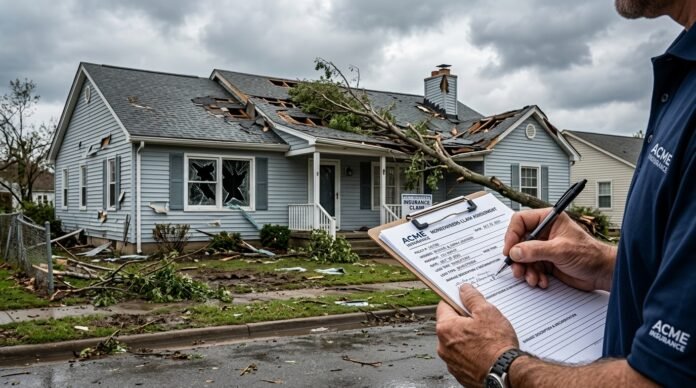
A major home loss can turn a familiar house into a complicated insurance and financial problem almost overnight.
A fire can destroy rooms and belongings. A severe storm can leave a roof exposed to further damage. A burst pipe can make portions of a home uninhabitable. A wildfire, hurricane, tornado or other catastrophic event can create damage that is far more extensive than what is visible during the first inspection.
For homeowners, the first instinct is often to focus on the physical damage: How much will it cost to repair the house?
But the financial consequences can extend much further.
There may be temporary housing expenses, damaged personal belongings, emergency repairs, deductibles, contractor costs, mortgage payments, coverage limits, and questions about whether particular damage is covered at all. The National Association of Insurance Commissioners (NAIC) notes that homeowners policies commonly provide separate coverage for the dwelling, other structures, personal property, liability and additional living expenses, but the exact protection depends on the policy and its limits.
That is why a major claim should not be treated as simply a matter of waiting for an insurance check.
Homeowners need to understand what the insurer believes happened, which portions of the loss are covered, how the settlement is being calculated, what documentation is required, and what expenses may be reimbursed while the property is being repaired or rebuilt.
The right questions can help reveal gaps before they become expensive surprises.
Here are eight questions homeowners should ask their insurer after a major home loss.
1. What Exactly Is Covered Under My Policy?
The first question should establish the boundaries of the claim.
A homeowner may see extensive damage and assume that everything associated with the event will be covered. Insurance does not necessarily work that way.
Coverage depends on the policy language, the cause of loss, applicable exclusions, deductibles, limits, endorsements and the type of property affected.
The NAIC explains that homeowners policies commonly include coverage for the dwelling, other structures, personal property, additional living expenses, personal liability and medical payments. However, certain risks such as flood and earthquake damage may require separate coverage or endorsements.
That distinction can become critical after a major disaster.
Ask for the coverage determination in specific terms
Rather than asking only, “Is my house covered?” ask the insurer:
- What cause of loss is being recognized?
- Which portions of the property damage are covered?
- Which portions are excluded?
- What deductible applies?
- Are there policy limits affecting the claim?
- Are any endorsements relevant?
- Are detached structures covered?
- Are personal belongings covered?
- Is temporary housing covered?
- Are there separate policies that may need to respond?
Getting specific answers early can help prevent a homeowner from making financial decisions based on an assumption about coverage.
For example, a homeowner could begin planning a major rebuild assuming that the insurer will pay for the entire project, only to discover later that a particular category of damage has a coverage limitation.
Coverage should be evaluated by category
A major loss is rarely just one expense.
There may be:
The structure: walls, roof, flooring, fixtures, built-in appliances and other components of the home.
Other structures: detached garages, sheds, fences, or similar property were covered.
Personal property: furniture, clothing, electronics, appliances and other belongings.
Loss of use: additional living expenses when the home cannot be occupied because of covered damage.
Each category can have different limits and rules.
Understanding those distinctions early gives the homeowner a clearer picture of the potential financial recovery.
2. How Is the Insurer Calculating the Amount of My Loss?
The second question is about the numbers.
After a major loss, homeowners may receive estimates from contractors, adjusters, restoration companies and other professionals. Those estimates do not necessarily use identical assumptions.
The insurer’s adjuster will evaluate the damage and determine the amount the company believes is payable under the policy. The NAIC explains that an adjuster reviews the policy, applicable deductibles and coverage limits and the extent of damage before the insurer determines the settlement.
That makes it important to understand how the settlement figure was produced, rather than focusing only on the final dollar amount.
Ask for an itemized explanation
A homeowner should be able to ask:
- What repair or replacement costs were included?
- Which items were excluded?
- What deductible was applied?
- Were depreciation deductions taken?
- Which coverage limit applies to each category?
- Were building code requirements considered?
- Were temporary repairs included?
- Are there additional payments available later?
The NAIC advises consumers to ask for an itemized explanation of a claim settlement offer when reviewing a homeowners insurance claim.
This documentation can be especially important if the homeowner’s contractor estimates a substantially different repair cost.
A difference does not automatically mean that either side is wrong. It may mean they are using different assumptions, materials, measurements, depreciation calculations or interpretations of the policy.
The homeowner needs to identify the difference before deciding how to proceed.
3. Is My Coverage Based on Replacement Cost or Actual Cash Value?
This question can have a major effect on how much money a homeowner ultimately receives.
Homeowners insurance may use different valuation approaches for the structure or personal belongings.
The NAIC distinguishes between replacement cost and actual cash value. Replacement cost generally refers to what it costs to replace or rebuild with materials of similar kind and quality without deducting depreciation. Actual cash value generally takes depreciation into account.
That difference can become significant after a major loss.
Imagine a roof that costs $20,000 to replace today but has substantial age-related depreciation.
If a settlement calculation applies actual cash value, the initial payment may be considerably lower than the full current replacement cost.
That does not necessarily mean the insurer has underpaid. The homeowner needs to understand what the policy promises and whether additional amounts may become available after qualifying repairs or replacement.
Ask the insurer:
“Is this payment based on replacement cost or actual cash value and under what circumstances could additional funds become available?”
That question can help clarify whether the first payment represents the entire expected settlement or only one stage of the claim.
4. What Documentation Do You Need From Me?
After a major loss, documentation can become one of the homeowner’s most valuable tools.
The NAIC recommends documenting damage with photographs and videos, creating a list of damaged property, preserving damaged items when possible for inspection and keeping receipts associated with repairs and other expenses.
That may sound straightforward.
After a catastrophic event, however, it can be surprisingly difficult.
A homeowner may be dealing with displacement, damaged records, disrupted utilities, contractors, family responsibilities and the emotional impact of losing personal possessions.
That makes it important to ask the insurer exactly what documentation is needed.
Ask whether the insurer needs:
- Photos and videos
- Receipts
- Contractor estimates
- Proof of purchase
- A personal property inventory
- Serial numbers
- Mortgage information
- Proof of temporary living expenses
- Proof of temporary repairs
- Building permits
- Previous renovation records
- A signed proof of loss form
- Other supporting documents
If an item was destroyed and there is no receipt, ask what alternative evidence the insurer will accept.
The NAIC notes that homeowners without a pre-existing inventory may need to reconstruct their belongings from memory, photographs, family or friends’ photos and online retail listings.
Keep your own claim file
Do not rely exclusively on the insurer’s records.
Keep copies of photographs, estimates, receipts, emails, letters, claim forms and notes from conversations.
It can also be useful to record the date of each conversation and the name or identification information of the person you spoke with.
The NAIC specifically recommends keeping detailed notes and copies of written communications related to insurance coverage and claims.
The objective is not to make the process adversarial.
It is to create a reliable record while the claim may involve many people and multiple stages.
5. What Temporary Repairs Should I Make and What Should I Wait to Repair?
After a major loss, homeowners often face an immediate dilemma.
There may be a hole in the roof.
Windows may be broken.
Water may still be entering the property.
A damaged structure may need to be secured.
Waiting for an adjuster to arrive may not be practical if additional damage could occur.
At the same time, making permanent repairs before the insurer has inspected the property can complicate the claim.
The NAIC recommends documenting losses first and then taking reasonable steps to prevent further damage. Examples include covering holes in roofs or boarding up broken windows. It also advises homeowners to keep receipts for temporary repairs.
The Insurance Information Institute similarly recommends making temporary repairs to protect the property while documenting the damage and preserving damaged items for inspection when possible.
Ask the insurer before major work begins
A useful question is:
“What temporary work should I authorize immediately and what permanent repairs should wait until the damage has been inspected?”
This creates a clearer distinction between emergency mitigation and reconstruction.
For example, covering a damaged roof to prevent additional water intrusion can be very different from replacing the entire roof before the insurer has inspected it.
Keep photographs of the damage before and after temporary repairs.
Keep invoices and receipts.
And when possible, preserve damaged materials or belongings until the insurer confirms they are no longer needed for inspection.
6. How Does Additional Living Expense Coverage Work?
A home may be technically standing but still be uninhabitable.
If a covered loss makes the property unsafe or unsuitable for occupancy, the homeowner may need to stay in a hotel, rental property or another temporary arrangement.
This is where Additional Living Expense (ALE) coverage can become important.
The NAIC explains that ALE coverage may help pay for expenses above a homeowner’s normal living costs when a covered loss makes the home unlivable. It can include temporary housing, certain additional food expenses and other qualifying costs. Policies can have both dollars and time limits.
There is an important detail homeowners sometimes overlook:
ALE generally does not mean the insurer pays for everything you spend while living somewhere else.
The NAIC explains that coverage generally applies to the additional expenses above what the homeowner would normally have spent. The mortgage payment, for example, generally remains the homeowner’s responsibility.
Ask these questions early:
- What is my ALE limit?
- Is there a time limit?
- What temporary housing expenses qualify?
- Are meals covered?
- Are storage expenses covered?
- Are transportation costs covered?
- Do I need prior approval before signing a lease?
- How should I submit receipts?
- What happens if repairs take longer than expected?
This can be particularly important after a catastrophic loss because rebuilding may take much longer than initially anticipated.
The NAIC notes that major disaster repairs or rebuilding can sometimes take 18 to 24 months or longer.
A homeowner who assumes temporary housing will be covered indefinitely could face a substantial financial gap if the policy’s limits are reached.
7. Who Will Be Handling My Claim and What Happens If the Estimate Changes?
Major claims can involve more than one insurance professional.
There may be an initial claims representative, an adjuster, specialists, engineers, contractors, restoration companies or other professionals depending on the nature of the loss.
The Insurance Information Institute notes that multiple claims professionals may become involved depending on the type of damage.
That can make it difficult for a homeowner to know who has authority to answer a particular question.
Ask the insurer:
- Who is my primary claims contact?
- Who is responsible for the property damage estimate?
- Will another specialist inspect specific damage?
- How should I submit new information?
- What happens if additional damage is discovered?
- How do supplemental estimates work?
- Who approves additional repair costs?
- How will contractor estimates be compared with the insurer’s estimate?
Don’t assume the first estimate is necessarily the final number
Major losses can reveal additional damage after walls, ceilings, flooring or other structures are opened.
A homeowner may initially believe the problem is limited to one area, only to discover hidden water damage, structural problems, mold, electrical issues or other related damage.
That is why it is useful to understand the insurer’s process for supplemental claims or revised estimates.
The goal is not to inflate the claim.
It is to make sure legitimate covered damage discovered during the repair process is properly documented and evaluated.
8. What Happens If I Disagree With the Claim Decision or Settlement?
Sometimes the homeowner and insurer will not initially agree about the amount of damage, the cause of loss, the scope of repairs or whether a particular item is covered.
That does not necessarily mean the process has reached its end.
The homeowner should first ask the insurer to explain the decision in writing and identify the policy language supporting it.
For example:
“Can you show me which provision of my policy supports this coverage decision?”
That question can turn a vague disagreement into a specific issue that can be examined.
The homeowner can then compare the insurer’s explanation with contractor estimates, photographs, policy documents and other evidence.
State insurance regulators can also be a resource
Insurance regulation in the United States is primarily state based.
The NAIC advises consumers who need help with claims or coverage to contact their state department of insurance.
Depending on the circumstances and state rules, a homeowner may also consider professional assistance from a qualified public adjuster or attorney.
A public adjuster works on behalf of the policyholder rather than the insurer, although the homeowner generally pays the public adjuster’s fee. The NAIC notes this distinction when explaining the claims process.
That means homeowners should understand the cost and terms of any representation before signing an agreement.
The Financial Questions Go Beyond the Insurance Check
A major home loss is ultimately an insurance issue, but it can quickly become a household financial issue as well.
Even with valid coverage, homeowners may face deductibles, temporary expenses, uncovered losses, timing gaps, contractor costs and mortgage obligations.
That is why the claim should be considered alongside the rest of the household’s financial position.
Keep Paying Attention to the Mortgage
Insurance proceeds do not generally eliminate the mortgage.
If the home is temporarily uninhabitable, the homeowner may still have to make mortgage payments while repairs are underway. ALE coverage is designed to help with qualifying additional living expenses, not to replace the mortgage obligation.
This can create a difficult period in which the household is simultaneously paying for:
- A mortgage
- Temporary housing
- Insurance deductibles
- Everyday living expenses
- Repairs or expenses not covered by insurance
A homeowner should therefore understand the timing of expected insurance payments rather than assuming the settlement will arrive before bills come due.
Be Careful About Borrowing to Bridge the Gap
A major loss can create pressure to use credit cards, personal loans, HELOCs or other borrowing while waiting for an insurance settlement.
Sometimes temporary financing may be necessary.
But homeowners should recognize that borrowing adds a second financial obligation to a situation that may already be expensive.
If a homeowner considers borrowing against home equity to fund repairs, the decision should account for the existing mortgage, the new debt payment, insurance costs, property taxes and the amount of equity that will remain after borrowing.
The fact that an insurance claim is pending does not automatically make additional borrowing low risk.
Don’t Let the Contractor Rush the Insurance Decision
Major disasters can attract large numbers of contractors and restoration companies.
Some may offer to begin immediately.
Rapid mitigation can be important, particularly where additional damage is occurring. But homeowners should be cautious about signing major permanent repair contracts before understanding the insurance scope and the contractor’s pricing.
The NAIC warns consumers about post disaster repair fraud and recommends checking references, avoiding pressure to sign quickly and obtaining multiple bids where appropriate.
A homeowner should also be wary of anyone promising that insurance will “definitely” pay for work before the insurer has made a coverage determination.
Ask before signing:
- Is this an emergency mitigation contract or a permanent repair contract?
- What exactly is included?
- Who is responsible for communicating with the insurer?
- What happens if the insurer approves less than the contractor estimates?
- Are there cancellation provisions?
- What deposits are required?
- Is the contractor licensed where required?
- Can references be checked?
The urgency of a disaster should not eliminate normal financial due diligence.
What Homeowners Should Keep in Their Claim File
A simple organizational system can make a major claim easier to manage.
Keep copies of:
- Insurance policy documents
- Claim number
- Adjuster contact information
- Photos and videos of damage
- Personal property inventory
- Contractor estimates
- Repair invoices
- Temporary repair receipts
- Hotel or rental receipts
- Food and other potentially qualifying ALE expenses
- Emails and letters from the insurer
- Written coverage decisions
- Proof of loss forms
- Mortgage information
- Records of previous improvements and renovations
The NAIC repeatedly emphasizes documentation, photographs, inventories and receipts throughout its consumer guidance on major property losses.
A well organized claim file is not merely administrative.
It can help the homeowner understand what has been submitted, what has been paid, what remains unresolved and where additional documentation may be necessary.
A Major Loss Is Also a Test of Your Insurance Coverage
The worst time to discover that a policy does not provide the protection a homeowner expected is after the house has already been damaged.
A major loss can expose differences between:
- Replacement cost and actual cash value
- Covered and excluded causes of loss
- Dwelling and personal property limits
- Standard and supplemental coverage
- Temporary repairs and permanent reconstruction
- Normal living expenses and additional living expenses
- Policy limits and the actual cost of rebuilding
That is why homeowners should treat the claim process as an opportunity to understand exactly what their policy does and does not provide.
If the settlement reveals a coverage gap, that information can become valuable when reviewing the policy after the claim is resolved.
The homeowner may discover a need to adjust dwelling coverage, update personal property limits, reconsider deductibles, add endorsements or obtain separate coverage for risks such as flooding or earthquakes where appropriate. The NAIC notes that flood and earthquake coverage may require separate policies or specific endorsements depending on the circumstances.
The Goal Is More Than Getting a Check
After a major home loss, it is natural to focus on the settlement amount.
But the more important objective is understanding how the entire recovery will work.
A homeowner needs to know what is covered, how the loss is being valued, which expenses can be reimbursed, what documentation is required, what repairs should happen immediately and what happens if the initial estimate proves insufficient.
The eight questions are therefore closely connected:
- What exactly is covered?
- How is my loss being calculated?
- Am I being paid on a replacement cost or actual cash value basis?
- What documentation do you need from me?
- Which repairs should I make now and which should wait?
- How does additional living expense coverage work?
- Who is handling my claim and what happens if the estimate changes?
- What can I do if I disagree with the claim decision or settlement?
The answers can determine far more than the size of an insurance check.
They can affect how quickly a family can return home, how much money it needs to borrow, whether temporary housing remains affordable and whether the household emerges from the loss with manageable finances or a much larger debt burden.
The Best Time to Understand Your Policy Is Before the Loss
A major home loss is one of the most stressful situations a homeowner can face.
The insurance policy is supposed to provide financial protection when that stress arrives, but homeowners still need to understand how the coverage operates.
Documenting the damage, preserving receipts, communicating clearly with the insurer, understanding deductibles and limits and asking detailed questions can make the claims process easier to navigate.
Most importantly, homeowners should avoid treating the insurance settlement as a single number.
A major claim is a financial process involving the property, personal belongings, temporary living arrangements, mortgage obligations, deductibles, repair costs and the terms of the insurance contract.
The more clearly a homeowner understands each piece, the easier it becomes to identify gaps, question unexplained differences and make informed decisions about the recovery.
After a major loss, getting the house repaired matters but understanding how the insurance coverage supports the entire financial recovery matters just as much.