
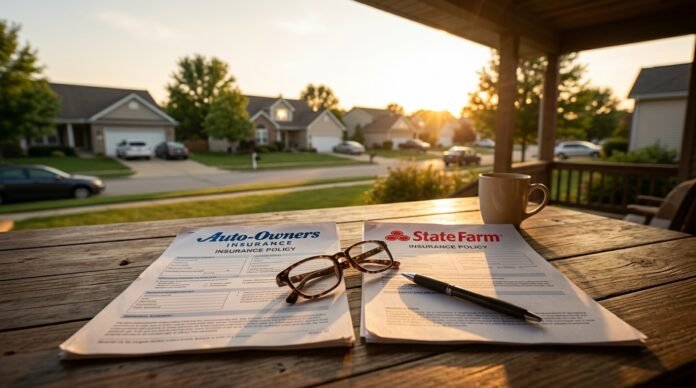
Choosing between homeowners insurance companies can look simple when the decision comes down to two quotes. If one insurer offers a lower annual premium, it may be tempting to assume the cheaper policy is the better deal.
That can be a costly assumption.
The real comparison is not just between Auto-Owners and State Farm as brands. It is between the specific policies, coverage limits, deductibles, endorsements, replacement cost provisions, exclusions and claims protections available to a particular homeowner.
Auto-Owners Insurance and State Farm both offer broad homeowners insurance, but their approaches are not identical. Auto Owners sells through independent agents and offers options such as Guaranteed Home Replacement Cost, Special Personal Property coverage, water-backup coverage and an Increased Cost endorsement. State Farm offers a broad homeowners package with dwelling, personal property, liability and additional living expense coverage, along with multiple discount opportunities and a large agent network.
That makes the comparison less about which company is universally “better” and more about which policy provides the protection a particular homeowner actually needs.
1. Start With the Home’s Replacement Cost
The first number homeowners should compare is not the home’s market value. It is the estimated cost to rebuild it.
State Farm explicitly distinguishes replacement cost from market value and recommends coverage at least equal to the home’s estimated replacement cost. Its guidance also notes that construction materials, labor costs, renovations and local market conditions can change the amount required to rebuild.
Auto Owners similarly base dwelling coverage around the estimated replacement cost of the home, with the agent helping determine the appropriate amount.
This matters because a home could sell for $500,000 while costing substantially more or less than that amount to reconstruct. The land, neighborhood desirability and other factors affecting market value do not necessarily translate into rebuilding costs.
When comparing quotes, homeowners should therefore ask:
- What replacement cost estimate did each insurer use?
- Are recent renovations included?
- Does the estimate account for local labor and material costs?
- Are custom finishes, upgraded kitchens or bathrooms included?
- What happens if actual rebuilding costs exceed the dwelling limit?
A lower premium achieved by using an unrealistically low dwelling limit is not a genuine saving.
2. Compare What Happens When Rebuilding Costs Exceed the Limit
This may be one of the most important differences to investigate.
Auto Owners offers a Guaranteed Home Replacement Cost option designed to address situations where the cost to rebuild exceeds the policy’s stated coverage amount. It also offers an Increased Cost endorsement that can provide an additional 25% above the dwelling limit when applicable.
State Farm also emphasizes keeping dwelling coverage aligned with current estimated replacement costs and says its coverage can automatically adjust each year to help account for changing construction costs. However, homeowners should still examine the exact policy provisions and available endorsements rather than assuming automatic adjustments eliminate the risk of being underinsured.
This distinction becomes especially important after a major catastrophe.
A localized loss may be relatively straightforward to repair. A widespread hurricane, wildfire, tornado or severe storm can create simultaneous demand for contractors, materials and temporary housing. Rebuilding costs can rise precisely when thousands of homeowners are competing for the same resources.
The question is therefore not simply, “How much dwelling coverage do I have?”
It is also:
“What financial protection exists if rebuilding costs are higher than expected?”
3. Compare Personal Property Protection
The structure of the house is only part of the financial risk.
Furniture, electronics, clothing, appliances, tools, artwork, jewelry and other possessions can represent hundreds of thousands of dollars in replacement costs for some households.
Auto Owners states that its homeowners policies cover personal possessions worldwide and offers optional coverage for special items such as jewelry and collectibles. It also offers Special Personal Property coverage that broadens protection for personal belongings.
State Farm similarly provides personal property coverage for belongings such as furniture, appliances, clothing and family heirlooms, but notes that homeowners policies can contain special limits for categories such as money, business property, watercraft, firearms and certain valuable property. Higher limits may be available when needed.
That means homeowners should not stop at the personal property limit shown on a quote.
They should ask:
- Is personal property settled at replacement cost or actual cash value?
- Are jewelry and collectibles subject to special limits?
- Is business property adequately covered?
- Are expensive electronics adequately protected?
- Can valuable items be scheduled individually?
- Are there exclusions or limitations that could affect a particular collection?
A policy with a lower premium may become significantly less attractive if expensive possessions require substantial out of pocket replacement costs after a loss.
4. Look Closely at Additional Living Expenses
A serious home loss can create costs that have nothing to do with rebuilding the structure itself.
If a house becomes uninhabitable after a fire or major storm, the family may need a hotel, temporary rental, meals and other expenses while repairs are completed.
Both companies provide protection in this area.
Auto Owners describes its Additional Living Expenses coverage as helping pay expenses when a homeowner cannot remain in the house after a covered loss, including costs such as hotel stays and food.
State Farm also includes loss of use protection among its homeowners coverage options.
But homeowners should compare the actual limits and conditions, not merely the existence of the coverage.
A three month displacement and a 12 month displacement can produce dramatically different expenses.
When comparing quotes, determine:
- What is the ALE limit?
- Is it a percentage of dwelling coverage or a fixed amount?
- Are there time limitations?
- What expenses qualify?
- Are there daily or category specific limits?
- What documentation is required?
This can be particularly important in areas where major disasters can leave homeowners waiting months for contractors, permits and materials.
5. Compare Water Related Coverage Carefully
Water damage is one of the areas where homeowners can easily misunderstand what their policy actually covers.
A homeowners policy may respond to certain sudden and accidental water losses while excluding other sources of water damage.
For example, State Farm explains that damage from a burst pipe may be covered depending on the circumstances, while flooding from an overflowing river or other body of water generally is not covered by a standard homeowners policy.
Auto Owners offer optional Water Backup of Sewers or Drains coverage, which can address certain damage involving floors, walls, furniture and electrical systems.
This is why comparing only the standard premium can be misleading.
Homeowners should ask both insurers about:
- Water backup
- Sewer backup
- Sump pump failure
- Burst pipes
- Roof related water intrusion
- Flood exclusions
- Mold limitations
- Drain and sewer damage
- Whether separate flood insurance is needed
Flood insurance is a separate issue from ordinary homeowners coverage. A property does not necessarily need to be located in a high risk flood zone for flooding to become a financial problem.
6. Compare Liability Protection
Homeowners insurance is not only about protecting the building.
It can also protect the homeowner’s finances when someone is injured on the property or when the homeowner becomes legally responsible for damaging someone else’s property.
Auto-Owners says its personal liability coverage can protect against lawsuits for which the homeowner or family may become liable, while medical payments coverage can apply to others injured at the residence.
State Farm likewise includes personal liability and medical payments among its homeowners coverage options.
The important comparison is therefore the liability limit, not merely whether liability coverage exists.
A homeowner with significant savings, investments, income or home equity may have more assets at risk than someone with a much smaller financial position.
Homeowners should consider whether the standard liability limit is sufficient and whether an umbrella policy makes sense for their circumstances.
7. Compare the Deductibles, Not Just the Premium
A lower annual premium does not automatically mean lower costs.
Sometimes the premium is lower because the homeowner has accepted a larger deductible.
That can make sense for households with substantial emergency savings. It can be problematic for homeowners who would struggle to produce several thousand dollars immediately after a major loss.
When comparing Auto Owners and State Farm, homeowners should put the quotes side by side and examine:
- All peril deductible
- Wind/hail deductible
- Hurricane deductible, where applicable
- Percentage based deductibles
- Roof related deductibles
- Any separate deductibles for specific risks
A policy costing $300 less per year may not be a bargain if it comes with a deductible that is thousands of dollars higher.
The right question is:
“Could I comfortably pay this deductible after a major loss?”
8. Compare Optional Coverage That Can Change the Policy’s Value
Two policies with similar base coverage can become very different once endorsements are added.
Auto Owners offers several notable optional coverages, including Guaranteed Home Replacement Cost, Special Personal Property, water backup protection and equipment breakdown coverage. It also advertises Home Cyber Protection for risks involving cyberattacks, cyber extortion, fraud and data breaches.
State Farm provides various homeowners coverage options and discounts, while coverage availability and specific policy provisions can vary by state.
The lesson is not that homeowners should automatically purchase every endorsement.
Instead, they should determine which risks matter most for their property.
For example, a homeowner with:
- A finished basement may prioritize water backup protection.
- A large jewelry collection may need specialized personal property coverage.
- A high value home may need stronger rebuilding protection.
- Smart home equipment may make equipment breakdown or cyber coverage more relevant.
- Significant assets may make higher liability limits or umbrella coverage more important.
The best policy is often the one that addresses the homeowner’s largest financial exposures, not the one with the longest list of optional features.
9. Compare the Companies’ Discount Structures
Price comparisons should include available discounts.
State Farm advertises discounts that can include claim free history, home and auto bundling, home security systems, impact resistant roofing, automatic sprinklers and certain wildfire mitigation measures. Availability varies by state.
Auto Owners offers discounts including multi policy savings, digital payment and document options, life multi policy discounts, payment history discounts and paid in full discounts. Eligibility and availability depend on the applicable policy and circumstances.
This creates an important distinction between the initial quote and the long term cost.
A homeowner should ask both companies to apply every discount for which the household actually qualifies.
It is also worth checking whether a discount could disappear later.
For example, a policyholder may receive a discount because of a particular payment arrangement, claims history or bundled policy. Changes to the household’s insurance portfolio can affect the final premium.
10. Consider How You Buy and Manage the Policy
The distribution model is another meaningful difference.
Auto Owners sells homeowners insurance through independent agents. Its website directs consumers to an independent agent who can help select coverage and obtain a quote.
State Farm also emphasizes its agent model, while offering digital tools for quoting, policy management and claims.
For some homeowners, the distinction matters.
An independent agent representing Auto Owners may be able to discuss policies from multiple insurers, depending on the agency’s appointments. A State Farm agent represents State Farm’s products but can provide direct assistance within that insurer’s system.
Neither approach is automatically better.
The more important question is whether the homeowner can get clear answers about coverage, exclusions, deductibles and claims procedures before purchasing the policy.
11. Don’t Assume the Bigger Insurer Automatically Offers the Better Policy
State Farm is considerably larger nationally in homeowners insurance.
According to the National Association of Insurance Commissioners’ 2025 countrywide homeowners multiple peril data, State Farm ranked first with approximately $35.27 billion in direct premiums written and an 18.69% market share. Auto Owners was also among the major U.S. homeowners insurers, although substantially smaller than State Farm by market share.
Scale can matter, but it should not be treated as a substitute for policy analysis.
A large national insurer may offer extensive resources, broad brand recognition and a large agent network. A smaller insurer may compete through specialized coverage options, independent agent relationships or particular service features.
The size of the company does not tell a homeowner whether a specific policy has the right replacement cost protection, deductible structure or endorsements.
12. Compare the Policies Side by Side Before Choosing
Before deciding between Auto Owners and State Farm, homeowners should request quotes based on the same coverage assumptions.
A useful comparison should include:
| Feature | Auto Owners | State Farm |
| Dwelling coverage | Compare estimated replacement cost | Compare estimated replacement cost |
| Other structures | Review limit and policy terms | Review limit and policy terms |
| Personal property | Compare settlement method and limits | Compare settlement method and limits |
| Valuable belongings | Special Personal Property available | Review special limits and available options |
| Guaranteed replacement | Available as an option | Review available policy options/endorsements |
| Additional living expenses | Compare limits and conditions | Compare limits and conditions |
| Liability | Compare limits | Compare limits |
| Water backup | Optional coverage available | Review available options |
| Deductibles | Compare all applicable deductibles | Compare all applicable deductibles |
| Discounts | Multi policy and other discounts | Bundling, claim free, security and other discounts |
| Agent model | Independent agents | State Farm agents |
| Flood | Separate consideration generally required | Separate consideration generally required |
The exact availability, limits, deductibles, exclusions and endorsements can vary by state and individual policy, so homeowners should use this table as a starting point rather than assuming every feature is available everywhere.
The Cheapest Quote May Not Be the Cheapest Policy
A homeowner comparing Auto Owners and State Farm should resist the temptation to make the decision based entirely on annual premium.
Insurance is a risk-transfer product. Its value becomes most obvious when something goes seriously wrong.
Imagine two homeowners with nearly identical houses. One pays $2,000 a year for coverage while another pays $2,300.
The cheaper policy might initially look like the obvious winner.
But suppose it has a higher deductible, less favorable protection for valuable belongings and weaker protection when rebuilding costs exceed the dwelling limit.
The additional $300 paid for the other policy could prove insignificant compared with the financial difference after a major loss.
That does not mean the more expensive policy is automatically better. It means homeowners should understand what they are buying with the difference in premium.
What Homeowners Should Ask Before Choosing
Before selecting either insurer, ask for clear answers to these questions:
- What is the current estimated replacement cost of my home?
- What happens if rebuilding costs exceed my dwelling limit?
- How are personal belongings settled after a claim?
- Are jewelry, collectibles, electronics and other valuables adequately covered?
- What are my exact deductibles?
- Are there separate wind, hail or hurricane deductibles?
- How much Additional Living Expense coverage do I have?
- Is sewer or water backup coverage included?
- What water related losses are excluded?
- What liability limit is included?
- Which discounts do I qualify for today?
- Could any of those discounts change later?
- Which endorsements would meaningfully improve my protection?
- Do I need separate flood insurance?
- How often should I update my replacement cost estimate?
These questions can reveal differences that a standard quote comparison may hide.
Auto Owners and State Farm can both provide substantial homeowners insurance protection, but the right choice depends on the policy details available to the individual homeowner.
Auto Owners stands out for options such as Guaranteed Home Replacement Cost, Special Personal Property coverage, water backup protection, equipment breakdown coverage and other endorsements. Its independent agent model also makes the purchasing experience different from a single carrier agency relationship.
State Farm offers broad homeowners coverage, replacement cost guidance, multiple discount opportunities and a large agent network. It also emphasizes regularly reviewing coverage as construction costs, home improvements and local conditions change.
Ultimately, homeowners should compare coverage before price.
The strongest policy is not necessarily the one with the lowest premium. It is the one that provides an appropriate balance of rebuilding protection, personal property coverage, liability protection, deductibles, additional living expenses and optional coverage without creating an unnecessary financial burden.
Before choosing between Auto Owners and State Farm, homeowners should place the actual policy declarations, limits, deductibles and endorsements side by side. That comparison can reveal whether a seemingly cheaper policy is truly cheaper or simply transferring more of the financial risk back to the homeowner.