
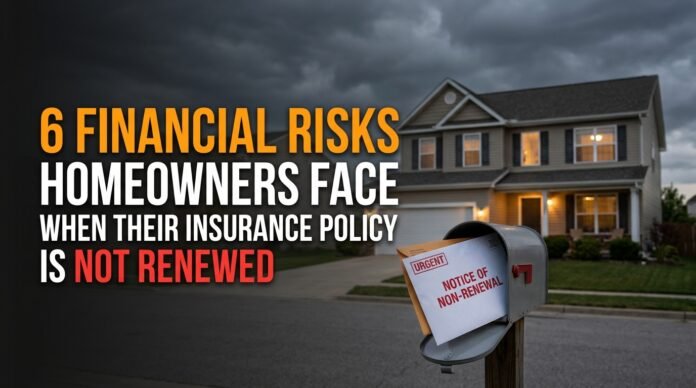
A homeowners insurance nonrenewal notice can create financial problems that extend well beyond the loss of an existing policy. For households with a mortgage, the immediate concern is finding replacement coverage before the current contract expires. However, the longer-term consequences can involve higher premiums, larger deductibles, reduced protection, unexpected property expenses, and difficulties meeting mortgage or property-sale requirements.
Insurance companies may decide not to renew a policy for several reasons, including changes in underwriting guidelines, the condition of the property, claims history, increased catastrophe exposure, or a decision to reduce their exposure in a particular market. A nonrenewal does not necessarily mean the homeowner did anything wrong. It means the insurer has decided not to continue the existing contract after its expiration date.
This distinction matters because nonrenewal is different from cancellation. Cancellation generally ends coverage before the policy’s scheduled expiration, while nonrenewal means the insurer allows the existing policy to expire without offering another term. The notice requirements and permissible reasons vary by state, so homeowners should review their state’s insurance rules rather than assume every insurer follows the same timeline.
The financial challenge begins when homeowners discover that replacing an established policy may not be as straightforward as obtaining another quote. A different insurer may assess the property differently, offer less favorable terms, or require repairs before accepting the risk.
Here are six financial risks homeowners should understand when their insurance policy is not renewed.
1. Finding Replacement Coverage Could Mean Paying a Much Higher Premium
One of the first financial consequences of nonrenewal is the possibility of paying more for replacement insurance.
Homeowners often remain with the same insurer for several years. During that time, the company has already evaluated the property, established its underwriting terms, and priced the policy according to its assessment of the household’s risk. When that relationship ends, the homeowner must approach another insurer and go through a new evaluation.
The replacement insurer may use different underwriting standards, risk models, property information and pricing assumptions. A roof that one company considered acceptable may receive additional scrutiny from another. Similarly, a property in an area exposed to hurricanes, wildfires, severe storms or other costly events may receive fewer competitive offers.
The homeowner may therefore discover that the available quotes are considerably higher than the previous premium.
Consider a household that previously paid $1,700 annually for homeowners insurance. After receiving a nonrenewal notice, it obtains replacement quotes ranging from $2,300 to $3,000. Even if the new policies offer similar headline coverage, the household could face an additional annual expense of several hundred to more than $1,000.
That difference can become difficult to absorb when other ownership costs are already increasing. Mortgage payments, property taxes, maintenance, utilities and home repairs compete for the same household income.
There is also a possibility that the replacement policy will require additional expenses before coverage begins. An insurer may request a roof inspection, electrical certification, plumbing repairs or evidence that certain safety concerns have been addressed.
The homeowner must then consider both the higher insurance premium and the cost of making the property acceptable to another insurer.
What homeowners should examine:
- Whether replacement quotes are based on the same dwelling coverage limit.
- Whether the new insurer is offering comparable personal property and liability protection.
- Whether the deductible is higher than under the previous policy.
- Whether the property requires repairs before coverage can be issued.
- Whether discounts from the previous insurer are available elsewhere.
- Whether the quoted premium includes all required endorsements and fees.
Homeowners should avoid accepting the first available quote simply because the nonrenewal deadline is approaching. Comparing multiple insurers, independent agents and available coverage arrangements can help reveal whether the higher price reflects a genuine market limitation or simply an unfavorable initial offer.
2. A Coverage Gap Could Expose the Homeowner to Major Out of Pocket Losses
The second risk is a lapse in insurance coverage.
A nonrenewal notice does not automatically create a coverage gap. The problem arises when the existing policy expires and the homeowner has not secured a suitable replacement.
This can happen when homeowners underestimate how long it takes to find another insurer, delay responding to inspection requirements or assume that a new policy will become effective automatically after the old one ends.
Even a relatively short period without insurance can expose a household to substantial financial losses.
Imagine a homeowner whose policy expires on June 30. The homeowner intends to arrange replacement coverage but is still comparing quotes when a severe storm damages the roof and allows rainwater to enter the property on July 2.
If no applicable insurance policy is in force, the homeowner may have to pay for eligible repairs, temporary accommodation, damaged belongings and other expenses without assistance from a homeowners insurer.
The financial exposure can be particularly serious because property damage is not always limited to the original incident. A roof failure may lead to water damage, electrical problems, damaged insulation and additional structural repairs.
A homeowner who cannot afford the necessary work immediately may also experience further deterioration.
The absence of coverage can create complications beyond physical property damage. Liability protection may also be missing. If a visitor is injured on the property during the uninsured period, the homeowner could face personal financial responsibility for a claim that might otherwise have been covered under a suitable homeowners policy.
There is another important issue: a new policy generally does not retroactively cover damage that occurred before its effective date. Purchasing insurance after a loss does not restore protection for an incident that has already happened.
What homeowners should examine:
- The exact expiration date and time of the existing policy.
- The effective date of the replacement policy.
- Whether the new insurer has completed the required underwriting process.
- Whether payment and documentation requirements have been satisfied.
- Whether liability and property coverage are active from the intended date.
- Whether any temporary or transitional coverage arrangement is available and appropriate.
Homeowners should obtain written confirmation of replacement coverage before the existing policy expires. They should not rely exclusively on a verbal assurance, an unfinished application or an estimate that has not yet been accepted.
The objective is to maintain continuous protection, even if the replacement policy has different limits or conditions.
3. Mortgage Lenders May Purchase Force Placed Insurance at the Homeowner’s Expense
For homeowners with an outstanding mortgage, nonrenewal can create an additional financial risk if the borrower fails to maintain insurance that meets the loan agreement’s requirements.
Mortgage contracts generally require borrowers to maintain adequate hazard insurance on the property. The lender has a financial interest in the home because it serves as collateral for the loan.
If the existing policy expires and the homeowner does not provide acceptable replacement coverage, the mortgage servicer may purchase insurance to protect the lender’s interest. This is commonly known as force placed or lender placed insurance.
The arrangement can be expensive because the homeowner is charged for the policy obtained by the lender.
The Consumer Financial Protection Bureau explains that force placed insurance is generally more expensive than coverage homeowners purchase themselves. It may also provide less protection because it is primarily designed to protect the lender rather than the homeowner.
For example, a homeowner who previously paid $2,000 annually for a comprehensive homeowners policy could face a substantially higher charge if the mortgage servicer purchases force-placed coverage after a lapse.
The exact premium depends on the property, lender arrangement and insurance contract, so homeowners should not assume there is one standard cost.
The coverage limitation is equally important. A lender-placed policy may protect the structure or the lender’s financial interest without providing equivalent protection for the homeowner’s furniture, clothing, electronics, personal liability or additional living expenses.
This means the household could be paying more for insurance while receiving less personal protection.
The mortgage payment may also increase if the lender adds the force-placed premium to the loan’s escrow account or otherwise charges the borrower for the expense.
Federal mortgage servicing rules establish notice requirements before a servicer assesses force-placed insurance charges. Under Regulation X, servicers generally must provide written notice at least 45 days before assessing the relevant premium or fee, subject to the regulation’s requirements and exceptions.
What homeowners should examine:
- Whether the mortgage contract requires continuous homeowners coverage.
- The minimum dwelling coverage and deductible requirements.
- Whether the lender has received proof of replacement insurance.
- Whether the mortgagee clause correctly identifies the lender or servicer.
- Whether any force placed insurance notice has been issued.
- Whether the lender has charged for coverage that is no longer necessary.
Homeowners should contact their mortgage servicer as soon as replacement coverage is arranged and provide the required documentation. If force placed insurance has already been purchased, they should request instructions for having it removed after acceptable replacement coverage is verified.
A nonrenewal should not automatically turn into an expensive mortgage related insurance problem. Prompt communication between the homeowner, insurer, agent and mortgage servicer can help prevent unnecessary charges.
4. Replacement Policies May Come With Higher Deductibles and Less Comprehensive Protection
Another financial risk is discovering that the available replacement policies do not offer the same coverage structure as the previous contract.
Homeowners sometimes focus on finding another insurer willing to accept the property without carefully examining the terms of the new policy. However, the replacement policy may have different deductibles, exclusions, coverage limits and settlement conditions.
This can create a situation in which the homeowner maintains insurance but has less financial protection when a claim occurs.
For example, a property previously insured with a $1,000 standard deductible might receive a replacement quote with a $2,500 deductible. The annual premium may appear competitive, but the homeowner must contribute an additional $1,500 toward a qualifying covered loss.
The difference could be greater when the replacement policy includes a separate percentage based hurricane or windstorm deductible.
Coverage limits can also change. A replacement insurer might offer a lower personal property limit, restrict certain water related coverage or apply different settlement provisions to the roof.
The homeowner may also discover that valuable belongings are subject to special limits or that sewer backup protection requires an additional endorsement.
In areas where insurers are reducing exposure to catastrophe prone properties, the available policies may be less flexible than those homeowners previously enjoyed.
For example, a household located in a wildfire exposed area might find that replacement insurers offer fewer options for certain property features or require additional mitigation measures. A coastal homeowner may encounter higher windstorm deductibles or need to obtain separate coverage for specific risks.
What homeowners should examine:
- Whether the new dwelling limit is sufficient to rebuild the property.
- Whether the replacement policy provides comparable personal property coverage.
- Whether the deductible is higher or calculated differently.
- Whether roof damage is settled at replacement cost or actual cash value.
- Whether water backup, additional living expenses and other important endorsements remain available.
- Whether flood or earthquake protection requires separate insurance.
A replacement policy should not be considered equivalent simply because it has the same annual premium or a similar headline coverage amount.
Homeowners should request the declarations page, policy forms and endorsements before accepting a new contract. If the available coverage is narrower, they should understand the financial consequences rather than assume the difference is insignificant.
5. State Backed Insurance Plans May Offer a Different Level of Protection
When private insurers are unwilling to provide suitable coverage, homeowners may need to investigate a state backed insurance arrangement.
Many states have created residual market mechanisms, including FAIR Plans and other property insurance programs, to help eligible homeowners obtain coverage when they cannot secure insurance through the standard market.
These arrangements can be important for properties in high risk locations or areas where private insurers have reduced their exposure.
However, a state backed plan should not automatically be treated as an identical replacement for a conventional homeowners policy.
FAIR Plans generally provide basic property protection for eligible risks, but their coverage limits, exclusions, deductibles, and available options vary by state. Some programs provide limited protection for specific perils, while others may require homeowners to arrange additional insurance to address important coverage gaps.
For example, a homeowner may obtain a basic property policy through a state plan but still need separate protection for liability, personal belongings or certain catastrophe related risks.
The total cost of maintaining adequate coverage can therefore involve more than the premium charged by the state backed program.
Some homeowners may also need to satisfy property condition requirements before becoming eligible. A deteriorating roof, unsafe electrical system or unresolved maintenance issue could create additional expenses.
The availability of these plans should not be assumed to be the same across the United States. Eligibility requirements, covered risks, policy limits and application procedures are determined by individual state programs.
The NAIC’s consumer guidance recommends contacting the state insurance department when a homeowner cannot find suitable coverage through the private market. The department can provide information about available FAIR Plans, wind pools and other residual market arrangements.
What homeowners should examine:
- Whether the state operates a FAIR Plan or another residual market program.
- Whether the property meets the program’s eligibility requirements.
- Which types of property damage are covered.
- Whether personal property and liability protection are included.
- Whether separate windstorm, flood or other catastrophe coverage is necessary.
- Whether the combined cost of multiple policies is affordable.
- Whether the program has specific property maintenance or mitigation requirements.
Homeowners should also continue exploring private market alternatives where appropriate. A residual market plan may provide an important coverage option, but its limitations should be understood before relying on it as the household’s primary insurance arrangement.
6. Property Repairs, Refinancing and Selling the Home Could Become More Expensive
The final risk is the effect nonrenewal can have on other financial decisions involving the property.
A home is often a household’s largest asset. Its insurance status can influence mortgage arrangements, refinancing decisions, maintenance planning and the ability to complete a sale.
When an insurer refuses to renew coverage because of a property condition, the homeowner may need to make repairs before another company is willing to insure the house.
For instance, a property with an aging roof might receive a nonrenewal notice because the insurer considers the roof too deteriorated for its underwriting standards. Another insurer may have similar requirements.
The homeowner could then face the cost of replacing the roof before obtaining affordable coverage.
The expense may become particularly difficult if the homeowner has limited savings or is already managing mortgage payments and other household obligations.
Refinancing can also become more complicated. Mortgage lenders generally require borrowers to maintain appropriate hazard insurance. If the homeowner cannot secure acceptable coverage, the borrower may encounter additional conditions or delays while trying to complete a refinancing transaction.
A property sale can create another complication. Buyers using mortgage financing typically need to arrange homeowners insurance before closing. If the property has a history of nonrenewal or has conditions that make insurance difficult to obtain, the buyer may face additional underwriting questions.
That does not mean a home cannot be sold after a nonrenewal. However, unresolved property issues and limited insurance availability can complicate the transaction, particularly when the buyer needs a mortgage.
There may also be pressure to sell at an inconvenient time. A homeowner who cannot afford the required repairs or the cost of replacement coverage might consider selling before the next renewal date. This can reduce negotiating flexibility and potentially increase the financial consequences of an already difficult situation.
What homeowners should examine:
- Whether the nonrenewal was connected to a specific property condition.
- Whether another insurer requires repairs before issuing coverage.
- Whether the mortgage lender has minimum insurance requirements.
- Whether refinancing depends on obtaining replacement coverage.
- Whether insurance availability could affect a prospective buyer.
- Whether delaying repairs could increase the cost of future maintenance.
Homeowners should avoid assuming that the loss of one policy means their property has become impossible to insure or sell. Instead, they should identify the reason for nonrenewal and determine whether the underlying issue can be corrected.
If the problem involves a roof, electrical system, plumbing or other physical condition, obtaining professional estimates can help establish the cost of bringing the property into acceptable condition.
What Homeowners Should Do After Receiving a Nonrenewal Notice
A nonrenewal notice should be treated as a time-sensitive financial issue, even when the policy will remain active for several more weeks.
The first step is to understand why the insurer has decided not to renew the policy. Homeowners should contact the company or agent and request a clear explanation. If the decision is based on property conditions, they should ask whether repairs or additional documentation could change the outcome.
The homeowner should also review the notice date and policy expiration date. State laws establish different requirements for nonrenewal notices and some states provide additional rights depending on how long the policy has been active or the reason for the decision.
A practical response should include:
- Request the reason for nonrenewal: Obtain a written explanation and identify whether the decision relates to property condition, underwriting changes, claims history or geographic exposure.
- Ask whether reconsideration is possible: If the concern involves repairs or outdated information, ask what evidence the insurer would accept.
- Begin shopping early: Contact multiple insurers and independent agents rather than waiting until the existing policy is close to expiration.
- Compare complete coverage: Review dwelling limits, deductibles, exclusions, personal property, liability and additional living expenses.
- Contact the mortgage servicer: Confirm the insurance requirements and provide replacement policy details as soon as coverage is arranged.
- Investigate state insurance resources: If private coverage is difficult to obtain, contact the state insurance department about available residual market options.
- Keep all documentation: Retain nonrenewal notices, inspection reports, contractor estimates, proof of repairs and new policy documents.
Homeowners who believe the insurer failed to follow applicable notice or underwriting rules can contact their state insurance department. Some states provide complaint procedures or appeal rights, although the available protections vary.
It is also important to distinguish between a nonrenewal decision and a cancellation during the policy term. The two actions have different legal requirements and a homeowner should not assume that the rules governing one automatically apply to the other.
A homeowners insurance nonrenewal can create financial consequences that extend far beyond finding another insurance company. Higher replacement premiums, coverage gaps, force-placed insurance charges, larger deductibles, residual market limitations and unexpected property expenses can all place additional pressure on a household.
The risks are particularly significant for homeowners with mortgages or properties located in areas where private insurance availability is becoming more limited. Even when replacement coverage is available, the new policy may have different terms that leave the homeowner responsible for more expenses after a loss.
The most important step is to act before the existing policy expires. Understanding the reason for nonrenewal, comparing alternative policies, addressing property concerns and keeping the mortgage servicer informed can help reduce unnecessary costs.
Ultimately, homeowners should view nonrenewal as a warning to reassess both their insurance arrangements and their property’s financial exposure. The goal is not simply to replace an expiring policy, but to maintain adequate protection without creating avoidable pressure on the household budget.