Getting out of debt is rarely a matter of simply deciding to pay more each month.
Most people who struggle with debt already know they should reduce their balances. The harder part is creating a plan that works alongside real life unexpected expenses, changing income, household bills, home repairs, insurance costs and the occasional financial setback.
That is especially true for homeowners.
A homeowner may be trying to pay off credit cards while also managing a mortgage, property taxes, homeowners insurance, maintenance and potentially other forms of debt. It can be tempting to throw every available dollar at debt, only to discover that one unexpected expense forces the household to borrow again.
A successful debt payoff strategy therefore needs to accomplish two things at the same time:
Reduce debt consistently while keeping the household financially stable enough to continue the plan.
The best strategy isn’t necessarily the one that eliminates debt the fastest on paper.
It is the one you can realistically follow month after month.
Start by Understanding What You Actually Owe
Before deciding how much to pay each month, create a complete picture of your debt.
List every balance, including:
- Credit cards.
- Personal loans.
- Auto loans.
- Medical debt.
- Student loans.
- HELOCs.
- Home equity loans.
- Other installment debt.
For each account, record:
- Current balance.
- Interest rate.
- Minimum payment.
- Due date.
- Remaining repayment period.
- Whether the interest rate is fixed or variable.
This step may seem basic, but it is essential.
It’s difficult to create a realistic payoff plan when you don’t know exactly what you’re trying to eliminate.
Don’t Focus Only on the Largest Balance
A large balance can look intimidating, but balance size alone doesn’t determine which debt deserves attention first.
Interest rates matter.
A $5,000 credit card balance with a very high interest rate can potentially be more financially urgent than a much larger loan with a substantially lower rate.
This is why homeowners should consider the cost of each debt rather than simply attacking the largest number.
Choose a Repayment Method
There are several common approaches to paying down debt.
Two of the most widely discussed are the debt avalanche and the debt snowball.
The Debt Avalanche
With the avalanche method, you generally prioritize the debt with the highest interest rate while making minimum payments on the others.
Once the highest-rate balance is eliminated, you move to the next one.
The potential advantage is mathematical efficiency.
You are directing additional money toward the debt that is costing you the most in interest.
The Debt Snowball
The snowball method focuses on the smallest balance first.
Once that debt is eliminated, the money that had been going toward it is redirected toward the next-smallest balance.
The advantage is psychological.
Paying off an account completely can create a visible sense of progress.
That momentum can make it easier for some people to stay committed.
Which Method Is Better?
There isn’t one method that works for everyone.
If minimizing interest costs is your primary objective, the avalanche approach may be appealing.
If motivation and quick wins are more important to you, the snowball approach may be easier to maintain.
The most important factor is consistency.
A theoretically optimal strategy that you abandon after three months is less useful than a slightly less efficient strategy you can maintain for several years.
Build the Plan Around Your Real Income
One of the biggest mistakes people make is creating a debt payoff target based on their best financial month.
Instead, base the plan on realistic income.
If your income varies, consider using a conservative estimate rather than assuming every month will be strong.
This creates room for fluctuations.
Any income above the baseline can then potentially be used for:
- Extra debt payments.
- Emergency savings.
- Home maintenance.
- Other financial goals.
A plan that works during an average month is much easier to maintain.
Don’t Forget the Cost of Owning a Home
Homeowners have financial responsibilities that renters generally don’t face.
Your debt plan should account for:
- Mortgage payments.
- Property taxes.
- Homeowners insurance.
- Utilities.
- Maintenance.
- Repairs.
- HOA fees where applicable.
A plan that sends every spare dollar toward credit cards while setting aside nothing for home maintenance may create another borrowing problem later.
A realistic debt strategy needs to account for the full cost of homeownership.
Build an Emergency Fund Before Going Too Aggressive
Debt repayment is important.
But having no cash reserves can make the household vulnerable.
Imagine paying an extra $1,000 toward a credit card and then experiencing a $1,500 emergency expense the following week.
Without savings, you may have to put the expense back on the credit card.
Now the balance has returned.
That’s why many homeowners benefit from maintaining at least some emergency savings while paying down debt.
The appropriate amount depends on your circumstances, income stability, household expenses, and financial obligations.
Separate Emergencies From Predictable Expenses
Not every large expense is actually an emergency.
If you know your property taxes are due every year, they should be included in your financial planning.
If your vehicle is aging, eventual repairs shouldn’t come as a complete surprise.
If your home needs maintenance, create a fund for those expenses.
Consider separate savings categories for predictable costs such as:
- Property taxes.
- Insurance.
- Home maintenance.
- Vehicle repairs.
- Annual bills.
- School expenses.
- Holidays.
This reduces the likelihood that predictable expenses will force you to use credit.
Make Your Minimum Payments Automatic
Missing payments can create unnecessary financial problems.
Whenever possible, automate at least the minimum payments on your accounts.
This can help reduce the risk of:
- Late fees.
- Missed payments.
- Credit damage.
- Accidental delinquency.
Then focus your additional payment toward your chosen priority debt.
Automation also removes one decision from your monthly routine.
Treat the Extra Payment Like a Bill
Instead of waiting to see how much money is left at the end of the month, make debt repayment part of your normal budget.
For example:
Income → essential expenses → savings → debt payment → discretionary spending
The exact order can vary, but the important point is that debt repayment should be intentional.
If you treat it as whatever money happens to remain, there may be very little left.
Don’t Create an Unrealistic Budget
This is where many debt payoff plans fail.
Someone decides to eliminate restaurants, entertainment, shopping, travel, hobbies and every other discretionary expense.
The first month went well.
The second month becomes difficult.
By the third month, the budget feels unbearable.
Eventually the homeowner abandons the plan entirely.
A sustainable budget should leave room for reasonable spending.
The objective isn’t to make your life miserable until the debt disappears.
It is to create a lifestyle that allows you to make consistent progress.
Give Yourself a Controlled Spending Allowance
A small amount of discretionary spending can actually make a debt plan easier to maintain.
Set a specific amount for nonessential purchases.
Once that money is gone, discretionary spending stops until the next budget period.
This creates boundaries without requiring total deprivation.
The exact amount isn’t important.
What matters is that it is intentional and affordable.
Use Windfalls Strategically
Occasional financial windfalls can accelerate debt repayment.
These may include:
- Tax refunds.
- Bonuses.
- Freelance income.
- Gifts.
- Side business profits.
- Unexpected financial gains.
You don’t necessarily have to put every dollar toward debt.
A balanced approach might divide the money between:
- Debt repayment.
- Emergency savings.
- Important household expenses.
- A small amount of discretionary spending.
The key is to avoid allowing temporary income to become permanent spending.
Don’t Increase Your Lifestyle Every Time Your Income Rises
A raise can be an opportunity to accelerate financial progress.
But lifestyle inflation can consume much of the additional income.
Instead of immediately increasing spending, consider directing at least part of the raise toward:
- Debt repayment.
- Savings.
- Retirement.
- Home maintenance.
You can still improve your lifestyle.
The goal is to ensure that your financial progress improves alongside your income.
Stop Adding New Debt
A payoff plan becomes much harder when new balances continue appearing.
This doesn’t mean every new loan is automatically irresponsible.
Homeowners may occasionally face unavoidable expenses.
But unnecessary new borrowing can undermine the entire strategy.
Before taking on additional debt, ask:
“Does this purchase need to happen now and is borrowing the only practical way to pay for it?”
That pause can prevent many unnecessary financial decisions.
Be Particularly Careful With Credit Cards
Credit cards can be useful financial tools, but carrying expensive revolving balances can make debt repayment significantly harder.
If you’re trying to eliminate credit card debt, consider whether continued use of the cards is helping or hurting your plan.
Some people find it easier to temporarily stop using cards while paying down the balance.
Others can use them responsibly while paying the statement balance in full.
The right approach depends on your habits.
The important thing is to prevent the balance from continually growing.
Don’t Automatically Use Your Home Equity to Solve Every Debt Problem
Homeowners have access to an asset that many other consumers don’t: home equity.
That can make a HELOC, home equity loan or cash out refinance appear attractive when credit card debt becomes expensive.
Sometimes consolidation can make financial sense.
But homeowners should understand what changes when unsecured debt is replaced with debt secured by the home.
Before using home equity, consider:
- Total interest costs.
- Fees.
- Repayment terms.
- Variable rate exposure.
- Remaining equity.
- Whether the original debt problem has actually been addressed.
A lower rate isn’t enough by itself.
If spending continues at the same level, new credit card balances can appear alongside the home-equity debt.
Know When Debt Consolidation Is Actually Helping
Consolidation can be useful when it simplifies payments or reduces borrowing costs.
But it should produce measurable improvement.
After consolidation, ask:
- Is total debt actually declining?
- Is monthly cash flow improving?
- Are interest costs lower?
- Are credit card balances staying down?
- Are you avoiding new borrowing?
If the answers are no, consolidation may have simply moved the debt rather than solved it.
Track Progress Every Month
A debt plan should be measurable.
At the end of each month, record:
- Total debt balance.
- Individual account balances.
- Interest paid.
- Amount paid toward principal.
- Emergency savings.
- Any new debt.
You don’t need complicated software.
A simple spreadsheet can be enough.
Seeing the numbers decline can provide motivation and reveal whether the strategy is actually working.
Measure Net Progress, Not Just One Balance
Suppose your credit card balance falls by $2,000 but your HELOC balance increases by $2,500.
Technically, you’ve paid down a credit card.
But your total debt has increased.
This is why homeowners should look at the entire debt picture.
Track:
Total debt = mortgage + HELOC + home equity loans + credit cards + other loans
The goal is to move the overall number in the right direction.
Expect Setbacks
A successful debt plan doesn’t require perfection.
Unexpected expenses will happen.
Income can change.
Home repairs can appear.
Plans can fail for a month.
The important thing is what happens next.
Instead of thinking:
“I failed, so the plan doesn’t work.”
think:
“Something changed. How do I adjust the plan?”
A flexible strategy is more likely to survive real life.
Create a “Bad Month” Version of Your Budget
One useful technique is to have two versions of your financial plan.
Normal Month
You make your standard extra debt payment.
Difficult Month
You reduce the extra payment temporarily while protecting:
- Housing.
- Utilities.
- Insurance.
- Minimum debt payments.
- Emergency savings.
This prevents one difficult month from completely derailing your strategy.
Don’t Sacrifice Necessary Insurance
When trying to reduce expenses, homeowners sometimes look for areas to cut.
Insurance can appear like an easy target.
But reducing necessary coverage simply to free up money for debt repayment can create significant financial risk.
A major loss could leave a homeowner facing a much larger financial problem.
Debt reduction should therefore be balanced with appropriate protection.
Keep Saving for Major Home Expenses
Homeowners should expect that the property will eventually require maintenance.
Roofing, plumbing, HVAC systems, appliances and other major components don’t last forever.
If you’re aggressively paying down debt, consider creating a dedicated home-maintenance reserve.
This can prevent the next major repair from becoming another credit card balance.
Consider Your Interest Rates Carefully
Not all debt deserves the same urgency.
High-interest debt can grow quickly.
Lower-interest debt may be less financially expensive, although other factors still matter.
A homeowner should consider the interest rate alongside:
- Loan term.
- Tax implications where applicable.
- Risk.
- Monthly cash flow.
- Financial goals.
The goal isn’t simply to eliminate whatever balance is easiest to see.
It is to improve the entire financial structure.
Don’t Forget Retirement
Debt repayment is important, but homeowners shouldn’t automatically abandon every other long-term financial goal.
Depending on the circumstances, it may make sense to continue contributing toward retirement while paying down debt.
This is particularly relevant when an employer offers a matching contribution.
The right balance depends on:
- Debt interest rates.
- Age.
- Income.
- Retirement timeline.
- Emergency savings.
- Employer benefits.
The goal is to avoid solving today’s debt problem by creating tomorrow’s retirement problem.
Use the Mortgage Strategically
For many homeowners, the mortgage is the largest debt they have.
But that doesn’t necessarily mean it should be the first debt they eliminate.
A homeowner with high interest credit card debt may benefit more from addressing that balance first.
Once expensive consumer debt is under control, additional money can potentially be directed toward:
- Mortgage principal.
- Retirement.
- Investments.
- Savings.
- Other financial priorities.
The right sequence depends on the household’s broader financial plan.
Build a Timeline but Don’t Obsess Over the Date
It can be motivating to set a target such as:
“I want to eliminate my credit card debt within three years.”
But don’t allow the deadline to become more important than sustainability.
If unexpected expenses slow progress, adjust the timeline rather than abandoning the plan.
Debt repayment is a financial process, not a race.
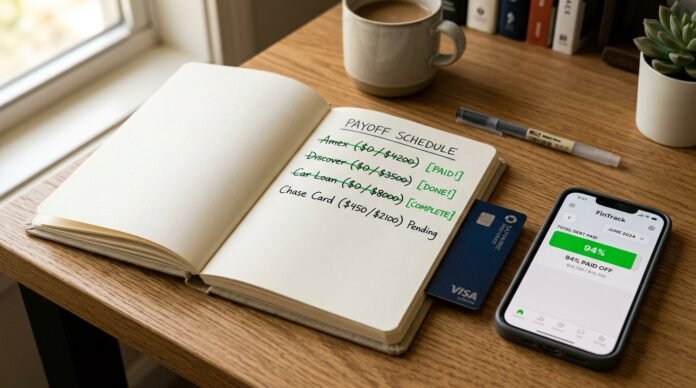
Make the Plan Visible
One surprisingly effective strategy is to make your progress visible.
You could track:
Starting debt: $30,000
Current debt: $24,500
Debt eliminated: $5,500
Seeing progress can reinforce good behavior.
The specific method doesn’t matter.
What matters is creating a clear connection between your monthly actions and your long term goal.
Celebrate Milestones Without Creating New Debt
Paying off a credit card or reaching a major debt milestone deserves recognition.
But celebration doesn’t have to mean expensive spending.
You could mark the occasion with something inexpensive or meaningful.
The goal is to reinforce the behavior:
Progress feels good.
That psychological reinforcement can make long-term discipline easier.
What to Do When You Feel Like You’re Not Making Progress
Debt can feel overwhelming when balances decline slowly.
Remember that interest can make early progress difficult.
Instead of focusing only on the total balance, look at:
- Number of accounts eliminated.
- Interest costs reduced.
- Monthly cash flow improved.
- Emergency savings increased.
- New borrowing avoided.
Financial progress isn’t always immediately visible.
A Simple Debt Payoff Framework
A practical strategy could look like this:
Step 1: List Every Debt
Know exactly what you owe.
Step 2: Calculate Your Monthly Cash Flow
Determine what you can realistically allocate.
Step 3: Protect Essential Expenses
Housing, utilities, insurance, food and other necessities come first.
Step 4: Maintain an Emergency Reserve
Avoid making yourself completely vulnerable.
Step 5: Choose Avalanche or Snowball
Pick the method you’re most likely to follow.
Step 6: Automate Minimum Payments
Avoid preventable late payments.
Step 7: Direct Extra Money Toward One Priority
Focus your additional payment rather than spreading it too thin.
Step 8: Avoid New Unnecessary Debt
Don’t undermine your progress.
Step 9: Review the Plan Monthly
Adjust when income or expenses change.
Step 10: Redirect Payments as Debts Disappear
When one balance reaches zero, send that payment toward the next target.
What Happens After You Become Debt Free?
This is a question many people forget to ask.
If you were previously sending $700 a month toward debt, that $700 doesn’t suddenly become “extra spending money.”
It can become a powerful wealth building tool.
Once expensive debt is gone, consider redirecting the money toward:
- Emergency savings.
- Retirement.
- Investments.
- Mortgage principal.
- Home maintenance.
- Other long term goals.
This is how debt repayment can become the foundation for wealth building.
The Real Goal Is Financial Flexibility
Being debt-free is valuable.
But financial flexibility may be even more important.
A homeowner with manageable debt, savings, adequate insurance and strong cash flow has more choices.
They may be able to handle:
- A temporary income reduction.
- A major home repair.
- A change in employment.
- A family expense.
- A future move.
- Retirement.
The goal of a debt payoff plan isn’t simply to make a balance reach zero.
It’s to create a household that becomes less dependent on borrowing.
A debt payoff plan doesn’t need to be complicated.
What it needs to be is realistic, measurable and sustainable.
The biggest mistake homeowners can make is creating a repayment strategy that looks impressive on paper but leaves no room for emergencies, maintenance, savings or normal life.
A strong plan recognizes that debt reduction is only one part of financial health.
You still need cash reserves. You still need to protect the home. You still need to account for insurance and property costs. You may need to save for retirement. And you need enough flexibility to deal with unexpected expenses without immediately reaching for another credit card or home equity loan.
The most effective debt strategy is therefore not necessarily the most aggressive.
It is the one you can continue when motivation fades, expenses rise and life doesn’t go according to plan.
Pay down debt consistently. Protect your financial foundation. Avoid replacing old debt with new debt. And make every financial decision with the goal of becoming less dependent on borrowing over time.
That’s how a debt payoff plan becomes more than a temporary financial challenge, it becomes a long term strategy for greater financial stability.