
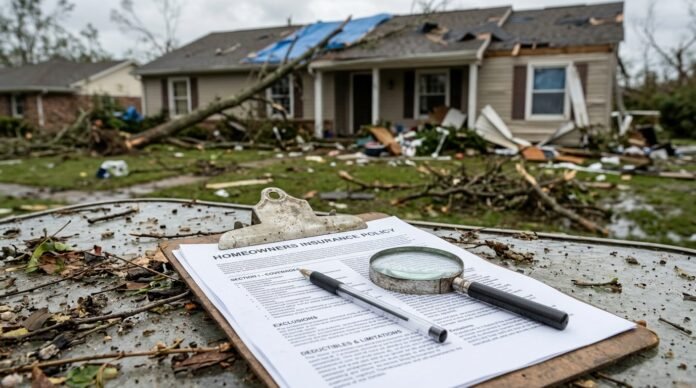
A major disaster can turn a homeowner’s understanding of insurance upside down. A policy that appeared comprehensive while premiums were being paid may provide less financial protection than expected when a fire destroys part of the house, a severe storm damages the roof or water spreads through several rooms. The difference often comes down to details that receive little attention until a claim is filed.
Homeowners insurance is designed to help cover specific losses, but it does not automatically pay every expense associated with repairing a property or returning a household to normal. Coverage limits, deductibles, exclusions, settlement methods and special conditions all influence how much an insurer pays and how much the homeowner must cover.
Understanding these provisions before a disaster can help households avoid unexpected bills, make more informed coverage decisions, and prepare for expenses that insurance may not fully reimburse.
1. The Difference Between Replacement Cost and Actual Cash Value
One of the most consequential details in a homeowners insurance policy is how the insurer calculates the value of damaged or destroyed property. Replacement cost and actual cash value may sound similar, but they can produce substantially different claim payments.
Replacement cost coverage generally pays the cost of repairing or replacing covered property with materials of similar kind and quality, without subtracting depreciation. Actual cash value (ACV) accounts for depreciation, including the property’s age, condition and expected useful life.
This difference can become expensive when a disaster affects older parts of a home or household belongings that have lost value over time.
For example, imagine a homeowner has a 12-year-old roof that costs $18,000 to replace with a comparable new roof. If the policy settles the roof loss using actual cash value, the insurer may deduct depreciation before applying the deductible. The homeowner could receive substantially less than the full replacement estimate.
A similar issue can arise with furniture, appliances, electronics, clothing, and other personal belongings. A family that paid $2,000 for a television several years ago may not receive enough under an ACV settlement to purchase a comparable replacement today.
Even policies advertised as providing replacement cost coverage require careful review. Certain property categories, particularly roofs or specific types of belongings, may have separate settlement provisions. Some policies also initially pay actual cash value and release recoverable depreciation only after the homeowner completes the repairs or replacement and provides the required documentation.
What homeowners should investigate:
- Whether the dwelling is insured on a replacement cost or actual cash value basis.
- Whether roofs, siding, flooring, and other building components have separate settlement rules.
- Whether personal belongings receive replacement cost or actual cash value treatment.
- Whether depreciation is initially withheld and what documentation is required to recover it.
- Whether the policy includes special limits for certain categories of property.
The distinction matters because a homeowner may technically have coverage for a loss while still facing a significant gap between the insurance payment and the cost of restoring the property.
2. Percentage Based and Disaster Specific Deductibles
A deductible is the amount the homeowner must pay toward a covered loss before the insurer contributes. Many people understand the concept but overlook how the deductible is calculated and whether different types of damage trigger separate amounts.
A standard homeowners policy may have a fixed deductible, such as $1,000 or $2,500. However, properties in areas exposed to hurricanes, windstorms or other severe weather may have separate catastrophe deductibles.
Some of these deductibles are calculated as a percentage of the home’s insured dwelling limit rather than a fixed dollar amount.
Consider a property insured for $400,000 with a 2% hurricane deductible. The homeowner could be responsible for the first $8,000 of an eligible hurricane related claim before insurance payments begin, subject to the policy’s terms.
That is a considerably different financial commitment from a standard $1,000 deductible.
The challenge is that homeowners may focus on the standard deductible displayed in their insurance documents without paying equal attention to separate windstorm, hurricane, named storm or other catastrophe provisions.
A policyholder might discover the difference only after a major weather event, when repairs are already urgent and household finances are under pressure.
Deductibles can also affect whether filing a smaller claim makes financial sense. If the estimated damage is close to the applicable deductible, the insurance payment may be limited or nonexistent.
What homeowners should investigate:
- The standard deductible for ordinary covered losses.
- Whether hurricane, windstorm, hail or named storm deductibles apply separately.
- Whether special deductibles are fixed amounts or percentages of dwelling coverage.
- Which events activate a separate deductible.
- Whether the deductible applies per occurrence, per claim or under another policy specific arrangement.
A lower annual premium may look attractive, but homeowners should understand the amount they would need to pay themselves after a major loss. The right deductible is not simply the one that reduces the insurance bill; it is one the household can realistically afford.
3. Coverage Limits That May Not Be Enough to Rebuild the Home
A homeowner may assume that having a $350,000 dwelling coverage limit means the insurer will provide enough money to reconstruct a destroyed house. That assumption can become costly if the policy limit is based on an outdated estimate or does not reflect current rebuilding expenses.
Dwelling coverage is generally intended to pay for covered damage to the home’s physical structure, subject to the policy limit and applicable conditions. However, the cost of rebuilding is not necessarily the same as the property’s market value or the amount originally paid for it.
Reconstruction expenses can include labor, building materials, demolition, debris removal, permits, architectural services and compliance with applicable building requirements. These costs can change significantly over time and may rise sharply after a widespread disaster when contractors and materials are in high demand.
For example, a homeowner may have purchased coverage based on a rebuilding estimate from several years earlier. After a regional storm damages thousands of properties, local demand for roofers, electricians, construction crews and building materials increases. The cost of restoring the home may then exceed the amount available under the policy.
The problem can be even more serious when the homeowner has made substantial improvements without notifying the insurer. A finished basement, additional bathroom, renovated kitchen or new extension may increase the property’s reconstruction cost without automatically increasing the dwelling limit.
Some policies offer extended or guaranteed replacement cost provisions that can provide additional protection when rebuilding expenses exceed the stated limit. However, these features have specific conditions, eligibility requirements, and limitations. They should not be assumed to exist simply because the policy provides replacement cost coverage.
Homeowners should also examine the limits for detached garages, fences, sheds, landscaping, and other structures. These may be insured separately under an other structures category, often with limits tied to the dwelling coverage amount.
What homeowners should investigate:
- Whether the dwelling limit reflects the current cost of rebuilding rather than the home’s resale value.
- When the insurer last reviewed the property’s replacement cost.
- Whether recent renovations and additions have been reported.
- Whether extended or guaranteed replacement cost coverage is available.
- Whether detached structures and other property features have sufficient limits.
- Whether demolition, debris removal and other rebuilding related expenses are subject to separate limits.
A policy can have a substantial headline coverage amount and still leave a homeowner short if the underlying rebuilding estimate is inaccurate.
4. Exclusions for Flooding, Earthquakes and Certain Water Damage
One of the most expensive misunderstandings about homeowners insurance is the belief that a standard policy covers every type of disaster that can damage a house.
In reality, insurance policies distinguish between different causes of damage. A homeowner may have coverage for water damage caused by a sudden burst pipe but no coverage for water entering the property through flooding from heavy rainfall or an overflowing river.
Flood damage is generally excluded from standard homeowners insurance and requires separate flood coverage, commonly purchased through the National Flood Insurance Program or a private insurer.
Earthquake damage is also generally excluded from standard homeowners policies. Homeowners who want protection against earthquake losses may need a separate policy or an available endorsement.
Water-related exclusions and limitations deserve particular attention because several incidents can produce similar visible damage while receiving different insurance treatment.
For example:
- A sudden plumbing failure may qualify for coverage, depending on the policy and circumstances.
- Water entering through a sewer or drain backup may require a specific endorsement.
- Floodwater entering through doors, windows or foundation openings is generally not covered by a standard homeowners policy.
- Gradual leaks and damage associated with poor maintenance may be excluded.
- Mold remediation may be limited or excluded depending on the cause, policy language, and applicable conditions.
A homeowner who experiences basement flooding after heavy rainfall could face a very different claims outcome from someone whose basement is damaged by a sudden covered plumbing failure.
The distinction becomes particularly important when a single storm produces several types of damage. Wind may damage the roof, rain may enter through the opening and rising water may subsequently affect the basement. The insurer may evaluate each part of the loss according to its cause and the applicable policy provisions.
What homeowners should investigate:
- Whether flood insurance is necessary for the property’s location and exposure.
- Whether earthquake coverage is available and appropriate.
- Whether sewer and drain backup coverage is included or requires an endorsement.
- How the policy treats sudden plumbing failures compared with gradual leaks.
- Whether mold remediation and water mitigation have separate limits.
- Whether storm related water damage is evaluated differently depending on how the water entered the home.
Homeowners should not rely exclusively on a property’s official flood zone classification when evaluating flood exposure. Local drainage problems, surface runoff, heavy rainfall and changing weather conditions can create risks even outside areas commonly regarded as high risk.
5. Personal Property Sublimits for Expensive Belongings
A disaster can destroy more than the physical structure of a house. Furniture, appliances, clothing, computers, jewelry, collectibles, musical instruments and other belongings may also be lost.
Homeowners insurance commonly includes personal property coverage, but that does not mean every possession is protected up to its full replacement value.
Many policies impose special limits on particular categories of belongings. These limits, often called sublimits, can apply even when the overall personal property coverage appears substantial.
For instance, a household might have $200,000 in personal property coverage but discover that the policy provides a much smaller limit for jewelry lost through theft. Similar restrictions may apply to watches, firearms, cash, silverware, artwork, collectibles and certain business related property.
The issue is not always whether an item is covered. It may be covered, but only up to a specified amount or under particular circumstances.
A homeowner with expensive jewelry, valuable artwork, rare collections or specialized equipment may therefore receive considerably less than expected after a covered loss.
There may also be differences between how an insurer settles claims involving ordinary household contents and high value possessions. Some items may need professional appraisals, purchase receipts, photographs or other evidence to establish their value.
Scheduling valuable property through an endorsement or separate coverage arrangement may provide broader protection or higher limits, depending on the insurer and policy.
What homeowners should investigate:
- Whether jewelry, watches, artwork, antiques and collectibles have special limits.
- Whether theft related limits differ from limits for other types of covered losses.
- Whether valuable possessions should be individually scheduled.
- Whether business equipment or inventory kept at home requires separate coverage.
- Whether the policy settles personal property losses using replacement cost or actual cash value.
- What evidence the insurer requires to establish ownership and value.
Maintaining a home inventory can make a significant difference during a claim. Photographs, videos, receipts, serial numbers and professional appraisals can help establish what was owned before the disaster.
Without adequate documentation, homeowners may struggle to demonstrate the value of their belongings, even when the policy provides coverage.
6. Additional Living Expenses That May Run Out Before Repairs Are Complete
A serious disaster can make a house temporarily uninhabitable. A fire, major storm, or covered structural loss may force a family to move into a hotel, rental property, or another temporary accommodation while repairs are underway.
Many homeowners policies include Additional Living Expenses (ALE), sometimes described as loss-of-use coverage. This protection can help pay for certain necessary expenses that exceed the household’s normal living costs while the home cannot be occupied because of a covered loss.
However, ALE does not mean the insurer will pay every expense the family incurs during displacement.
Coverage is generally subject to the policy’s terms, limits and time restrictions. The insurer may reimburse reasonable additional costs rather than the family’s entire temporary living budget.
For example, a family that normally spends $2,000 per month on housing and related living expenses may temporarily spend $4,000 because it needs to rent suitable accommodation after a fire. The additional amount may be considered under ALE, subject to the policy’s eligibility rules and limits. The family remains responsible for its ordinary expenses, such as its mortgage payment.
The financial pressure can increase when repairs take longer than expected. Contractor shortages, permit delays, material availability, disputes over repair estimates and additional damage discovered during construction can extend the displacement period.
If the policy has a maximum dollar amount or time limit, the family may have to pay more of its temporary housing expenses once that protection is exhausted.
Homeowners should also understand what the insurer considers reasonable and necessary. A temporary rental that is significantly more expensive than the household’s usual living arrangements may require additional justification or insurer approval.
What homeowners should investigate:
- The total dollar limit for additional living expenses.
- Whether coverage is restricted by a maximum period.
- How the insurer determines whether the home is uninhabitable.
- Whether hotel bills, rental costs, meals, laundry, storage and transportation qualify.
- Whether the insurer pays providers directly or reimburses the homeowner.
- What documentation is required for reimbursement.
- How the policy handles extended repairs and delays outside the homeowner’s control.
Keeping receipts and maintaining communication with the claims adjuster are essential. Homeowners should also ask how ALE payments are calculated before committing to expensive temporary arrangements.
How Homeowners Can Reduce the Risk of Expensive Coverage Surprises
Reviewing an insurance policy only after a disaster is a difficult way to discover its limitations. A better approach is to examine the contract periodically and focus on how it would respond to realistic losses affecting the property.
The declarations page provides an important starting point because it summarizes major coverage limits, deductibles and policy information. However, homeowners should also review the full policy, including exclusions, endorsements, conditions and special limits.
A practical review should include the following steps:
- Reassess rebuilding costs: Confirm that dwelling coverage reflects the current cost of reconstruction, including labor and materials.
- Understand settlement methods: Determine whether the home, roof and personal belongings are insured on a replacement cost or actual cash value basis.
- Calculate potential deductibles: Work out the actual dollar amount of percentage based hurricane, windstorm or other special deductibles.
- Identify excluded disasters: Check whether flood, earthquake, sewer backup and other relevant risks require additional coverage.
- Review valuable possessions: Identify belongings that may exceed standard personal property sublimits and investigate scheduled coverage.
- Evaluate displacement protection: Make sure additional living expense limits are realistic for the local cost of temporary accommodation and the possibility of lengthy repairs.
Homeowners should also review their coverage after major renovations, expensive purchases, changes in household circumstances and significant changes in local construction costs.
An insurance agent or company representative can help explain available endorsements and policy provisions, but homeowners should request specific answers rather than relying on general assurances that the property is fully protected.
The financial consequences of a disaster depend on more than the amount of homeowners insurance a household carries. The method used to value damaged property, the size of the deductible, rebuilding limits, disaster exclusions, personal property sublimits and additional living expense provisions can all influence the final amount an insurer pays.
These details may seem minor during an ordinary renewal, but they can become major financial issues when a household is trying to repair a damaged home, replace essential possessions or find temporary accommodation.
Homeowners who understand these provisions before a loss are better positioned to identify coverage gaps, evaluate additional protection and prepare for expenses that may not be reimbursed. The goal is not simply to maintain an active insurance policy but to understand what that policy can realistically provide when the household needs it most.