
Refinancing used to be simple.
If rates dropped, you refinanced. If they didn’t, you waited.
Today, it’s not that straightforward.
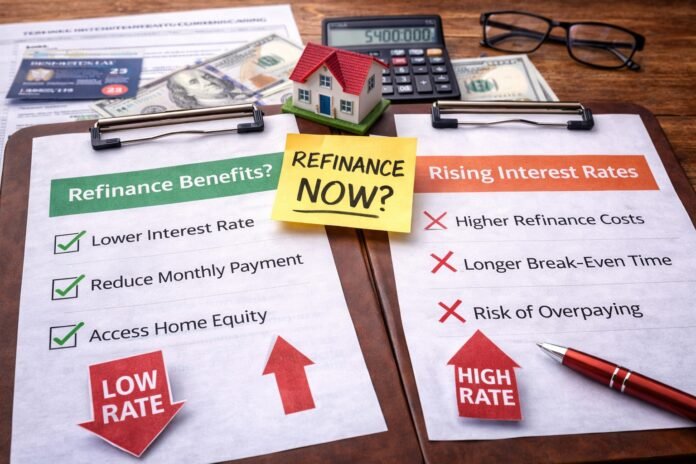
With interest rates elevated compared to recent historic lows, refinancing decisions require sharper math and clearer strategy. The question isn’t just “Can I lower my rate?” It’s “Does refinancing still make financial sense right now?”
Let’s break it down.
1. The Low Rate Era Changed the Equation
Millions of homeowners locked in mortgage rates between 2.5% and 4% in recent years.
If you’re sitting on one of those loans, refinancing at today’s higher rates likely increases your monthly payment. That alone eliminates the traditional “rate-and-term” refinance advantage.
In a rising rate environment, refinancing is less about chasing lower rates and more about restructuring debt strategically.
2. Cash Out Refinancing Is More Expensive Now
When rates rise, cash-out refinancing becomes significantly more costly because:
- You’re replacing your entire mortgage balance
- The new rate applies to the full loan amount
- Monthly payments often increase
For homeowners who want to access equity, refinancing now means repricing 100% of your loan at today’s rates.
That’s a major shift compared to past years.
3. Break Even Calculations Matter More Than Ever
Refinancing comes with costs:
- Origination fees
- Appraisal fees
- Closing costs
When rates are high, the break even period the time it takes for savings to offset closing costs can stretch much longer.
If you plan to move within a few years, refinancing may not pay off.
Right now, calculating total cost over time is more important than focusing on monthly payment alone.
4. Debt Consolidation Through Refinancing Is Riskier
Some homeowners refinance to roll high interest debt into their mortgage.
While mortgage rates may still be lower than credit card APRs, rising rates narrow that gap. Additionally, you’re converting unsecured debt into secured debt tied to your home.
That raises the stakes.
If consolidation is the goal, comparing refinancing against other tools may be necessary before committing.
5. Shorter Term Refinances May Make More Sense
Instead of extending to another 30-years loan, some homeowners are:
- Switching from adjustable to fixed
- Moving from 30-years to 15-years terms
- Refinancing to stabilize unpredictable payments
In higher rate environments, predictability becomes more valuable than chasing the lowest possible rate.
6. When Refinancing Still Makes Sense
Despite higher rates, refinancing can still be smart if:
- Your current rate is significantly higher than market rates
- You need to remove private mortgage insurance (PMI)
- You’re restructuring loan terms strategically
- You’re improving cash flow in a way that supports long-term goals
The key is alignment not trend-following.
7. The Psychological Trap
Many homeowners are stuck comparing today’s rates to the lowest rates in history.
But those rates were abnormal.
Financial decisions should be based on current conditions and personal numbers not nostalgia for past markets.
Rising interest rates don’t eliminate refinancing. They just change the criteria.
Today, refinancing decisions require:
- Careful break even analysis
- Clear long term plans
- Honest assessment of total interest costs
For some homeowners, refinancing right now is strategic. For others, holding their existing mortgage and exploring alternatives may be smarter.
The right move isn’t about timing the market perfectly. It’s about understanding your numbers and protecting your long term equity position.
In another related article, 7 Mistakes Homeowners Make When Refinancing (And How to Avoid Them)