
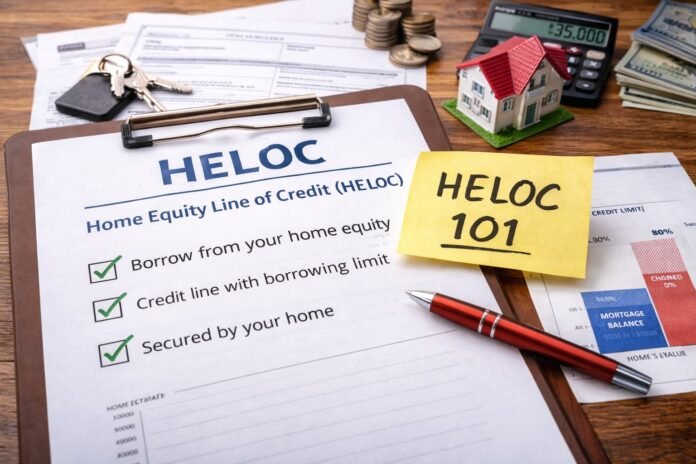
If you own a home and have built equity, you’ve probably heard about HELOCs.
They’re often mentioned alongside refinancing and home equity loans, but they work differently and understanding the mechanics matters before you use one.
Let’s break it down clearly.
What Is a HELOC?
A Home Equity Line of Credit (HELOC) is a revolving credit line secured by your home.
Instead of receiving a lump sum, you’re approved for a credit limit based on your available equity. You can borrow from it as needed, repay it and borrow again during a set period.
Think of it as a credit card backed by your house but typically with lower interest rates.
How Home Equity Is Calculated
Your available equity is the difference between:
- Your home’s current market value
- What you still owe on your mortgage
Most lenders allow you to borrow up to 80%-85% of your home’s value, minus your remaining mortgage balance.
Example:
- Home value: $400,000
- Mortgage balance: $250,000
- 80% of value: $320,000
Potential borrowing capacity: $70,000
(Exact limits vary by lender.)
The Two Phases of a HELOC
A HELOC has two main stages.
1. Draw Period (Typically 5-10 Years)
During this time, you can:
- Borrow funds up to your limit
- Make minimum payments (often interest only)
- Repay and reuse available credit
You’re only charged interest on what you actually borrow.
2. Repayment Period (Typically 10-20 Years)
Once the draw period ends:
- You can no longer borrow
- You begin repaying both principal and interest
- Monthly payments usually increase
This transition is important. Many homeowners underestimate how payments change when repayment begins.
How HELOC Interest Rates Work
Most HELOCs have variable interest rates, meaning:
- Your rate moves with market conditions
- Payments can rise if rates increase
Some lenders offer fixed rate options for portions of the balance, but variable structures are more common.
Because rates can fluctuate, HELOCs are often best for borrowers with a clear repayment plan.
Common Uses for a HELOC
Homeowners often use HELOCs for:
- Home renovations
- Debt consolidation
- Emergency expenses
- Education costs
- Large planned purchases
The flexibility is what makes them attractive. You borrow only what you need, when you need it.
HELOC vs Home Equity Loan
A HELOC is not the same as a home equity loan.
| HELOC | Home Equity Loan |
| Revolving credit line | Lump sum loan |
| Often variable rate | Often fixed rate |
| Flexible borrowing | Fixed payment structure |
The right choice depends on whether you need flexibility or predictable payments.
Risks to Understand
Because your home secures the loan:
- Missed payments can lead to foreclosure
- Rising rates can increase monthly costs
- Overspending can create long term financial strain
A HELOC can be a powerful financial tool but only if used strategically.
When a HELOC Makes Sense
A HELOC may be worth considering if:
- You have strong equity
- You want flexible access to funds
- You’re comfortable with variable rates
- You have a disciplined repayment strategy
It’s less ideal for long term, passive borrowing without a plan.
A HELOC isn’t free money. It’s leveraged equity.
Used carefully, it offers flexibility and potentially lower borrowing costs than credit cards or personal loans. Used casually, it increases risk because your home is on the line.
Before opening a HELOC, compare:
- Your current mortgage rate
- Available HELOC rates
- Total repayment cost
- How long you’ll need the funds
The smartest borrowers treat equity as a tool not an extension of income.
In another related article, Why More Homeowners Are Using HELOCs Instead of Refinancing