
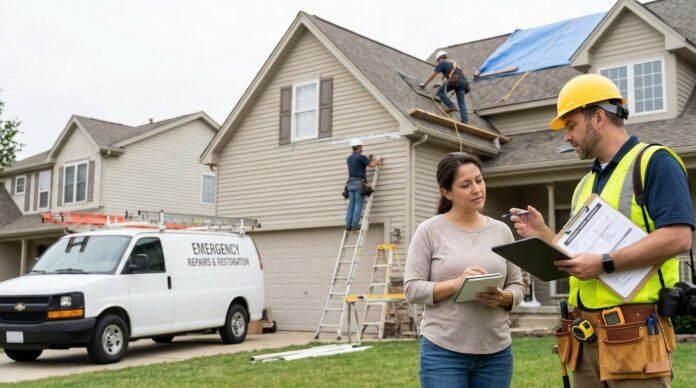
When a home suffers damage from a storm, fire, burst pipe or another unexpected event, homeowners often need to act quickly. A leaking roof can allow more water into the property, a broken window can expose the interior to weather, and standing water can lead to additional damage if it is not addressed promptly.
However, emergency repairs can create a second financial problem if homeowners pay for work without understanding their insurance coverage, documenting the damage or checking the contractor’s terms. An expense that seems unavoidable at the moment may not be reimbursed in full and money spent on temporary repairs may reduce the amount remaining for other parts of an insurance settlement.
The challenge is to protect the property without making costly decisions under pressure. Homeowners may need to authorize immediate work to prevent further damage, but that does not mean they should agree to every repair proposal or assume their insurer will cover the entire bill.
Before paying for emergency repairs, homeowners should ask five important questions about insurance reimbursement, repair authorization, contractor reliability, documentation and their ability to manage costs.
1. Does My Homeowners Insurance Policy Cover These Emergency Repairs?
The first question is whether the damage and the proposed repairs fall within the terms of the homeowner’s insurance policy. This distinction matters because homeowners insurance does not cover every cause of property damage and reimbursement depends on the circumstances of the loss and the policy’s specific provisions.
For example, a storm may damage roof shingles and allow rainwater to enter the house. If the event is covered, reasonable temporary work to protect the property may qualify for reimbursement as part of the claim. However, if the damage resulted from an excluded cause, such as certain forms of deterioration or neglect, the homeowner may be responsible for more of the expense.
The same issue can arise with water damage. A sudden plumbing failure may be treated differently from a gradual leak that developed over an extended period. Flooding from rising water may also require separate flood insurance rather than relying on a standard homeowners policy.
What to ask the insurer
Before authorizing nonessential work, contact the insurance company or agent and ask:
- Is the reported cause of damage covered under my policy?
- Are emergency mitigation services, such as roof tarping, boarding up windows or water removal, potentially reimbursable?
- Are there limits on the amount I can spend on temporary repairs?
- Does the policy require the insurer to inspect the damage before permanent repairs begin?
- Are any special deductibles, exclusions or coverage limits likely to apply?
The insurer may not be able to confirm the final amount payable until an adjuster examines the damage. Nevertheless, an early conversation can clarify the claim process and help the homeowner understand which expenses need additional approval.
The National Association of Insurance Commissioners advises policyholders to report losses, document damage and contact their insurer before proceeding with repairs where possible. It also explains that reasonable temporary repairs may be reimbursable when the underlying loss is covered.
Source: NAIC – Navigating the Claims Process: Recover and Rebuild.
Why this matters financially
Imagine that a homeowner receives a $2,500 estimate for emergency water removal and temporary repairs after a plumbing incident. The homeowner pays immediately, assuming insurance will cover the entire amount. Later, the insurer determines that some of the damage resulted from a condition excluded under the policy.
The homeowner could be left responsible for expenses that were expected to be reimbursed.
That does not mean homeowners should delay necessary steps to prevent additional damage while waiting for a final coverage decision. Instead, they should report the loss promptly, ask what work is reasonable and necessary and keep a record of the insurer’s instructions.
The practical takeaway: Confirm potential coverage before committing to substantial spending, but do not neglect urgent measures needed to protect people or prevent further property damage.
2. Is This Work an Emergency Temporary Repair or a Permanent Repair?
Not every repair needs to happen immediately. Understanding the difference between emergency mitigation and permanent restoration can help homeowners protect their property without committing prematurely to a large project.
Emergency repairs are generally intended to make a property safer, secure exposed areas or prevent additional damage. Examples may include covering a damaged roof with a tarp, boarding up a broken window, shutting off a leaking water supply or arranging appropriate water removal.
Permanent repairs restore damaged components or replace them with lasting materials. These projects may involve installing a new roof, replacing damaged flooring, rebuilding walls, repairing structural components or undertaking extensive restoration after a fire.
Why the distinction matters
After a severe storm, a contractor might offer to cover a damaged roof immediately and then replace the entire roof the following day. The temporary covering may be necessary to stop further water intrusion, but the permanent project could require a more detailed inspection, a written scope of work and coordination with the insurer.
If homeowners authorize extensive repairs before the damage has been fully documented, they may make it harder for an adjuster to assess the original condition. They may also pay for work that is not included in the insurer’s estimate or that exceeds the policy’s available coverage.
The Michigan Department of Insurance and Financial Services recommends making reasonable temporary repairs to prevent additional losses, saving receipts and avoiding permanent repairs until the insurer has inspected the damage.
Source: Michigan Department of Insurance and Financial Services – Disaster Preparedness and Recovery.
What should homeowners do first?
Before paying for repairs, consider the following sequence:
- Address immediate safety risks. If the property may have structural damage, exposed electrical wiring, a gas leak or another serious hazard, keep people away and contact the appropriate emergency or utility professionals.
- Document the damage. When it is safe, take photographs and videos before cleanup or repair work changes the scene.
- Report the loss. Contact the insurer as soon as practical and follow its instructions for handling the claim.
- Authorize necessary temporary work. Focus on reasonable measures that protect the property and prevent additional damage.
- Discuss permanent work separately. Ask whether an adjuster needs to inspect the property and whether the proposed scope and estimate should be reviewed first.
There are circumstances in which immediate work cannot reasonably wait for an inspection. If that happens, document the damage thoroughly before work begins whenever it is safe to do so, retain records of the repairs and notify the insurer promptly.
Avoid letting urgency become an open ended commitment
A contractor who agrees to secure a damaged window or stop an active leak is not automatically authorized to undertake a complete renovation. Homeowners should confirm exactly what the initial payment covers and whether additional work requires separate approval.
The practical takeaway: Pay for necessary emergency mitigation when circumstances require it, but distinguish that work from permanent repairs that may be better evaluated after the insurer has reviewed the loss.
3. Is the Contractor Qualified and Are the Price and Payment Terms Reasonable?
Property damage creates a difficult environment for making purchasing decisions. Homeowners may be displaced, worried about further losses and eager to return their property to normal. Contractors who offer immediate assistance can be valuable, but disaster situations also attract businesses and individuals who exploit the urgency.
The Federal Trade Commission warns that disaster related repair scams can involve unlicensed contractors, demands for large upfront payments, incomplete work and attempts to obtain money through misleading promises.
Source: Federal Trade Commission – Four Ways to Avoid Scams After a Weather-Related Disaster.
What should homeowners verify?
Before handing over money, homeowners should check the contractor’s identity, qualifications and proposed work.
Licensing and insurance. Verify that the contractor holds any license required by state or local law. Ask for proof of liability insurance and, where applicable, workers’ compensation coverage.
Business reputation. Look for independent reviews, references and evidence of previous work. A business operating locally with a verifiable history may be easier to assess than an unfamiliar contractor who appears immediately after a disaster.
Written estimate. Request an itemized estimate that identifies the work, materials, labor, equipment charges and any additional fees. The description should be specific enough to understand what is being purchased.
Contract terms. Read the agreement carefully. It should identify the contractor, describe the scope of work, outline the payment schedule and explain how changes or additional charges will be handled.
Payment arrangements. Be cautious about demands for the full price upfront, particularly when the contractor has not begun work. Where a deposit is necessary, check applicable state laws and agree on a reasonable amount and payment schedule.
Why comparing estimates can protect household finances
For major repairs, obtaining more than one estimate can help homeowners identify unusually high prices or suspiciously low bids. A very low quote may omit essential work, use inferior materials or lead to unexpected charges later.
Emergency situations can make comparisons difficult, especially when a roof is exposed or water is still entering the property. Homeowners do not need to postpone urgent protective work merely to collect multiple bids. They can, however, limit the initial authorization to essential work and obtain more detailed estimates before committing to a larger project.
Watch for assignments and promises involving insurance payments
Some contractors may ask homeowners to sign an assignment of benefits or another document that transfers certain rights under an insurance claim. Such agreements can have significant consequences for who controls payments or communicates with the insurer.
The effect depends on the document and applicable state law. Homeowners should not sign an unfamiliar agreement simply because a contractor says it is required for emergency service.
They should also be wary of contractors who promise to guarantee insurance coverage, waive the deductible or secure a particular settlement amount. A contractor can estimate repair costs, but the insurer determines coverage under the policy, subject to applicable law and the claims process.
The practical takeaway: Verify the contractor, obtain written terms and avoid large or unexplained upfront payments. Urgent repairs should not require surrendering control of the entire insurance claim without careful review.
4. Have I Documented the Damage, the Repairs and Every Payment?
Documentation can be one of the most valuable financial tools available to homeowners after property damage. Photographs, estimates, invoices and payment records help establish what happened, what work was performed and how much the homeowner spent.
Without those records, it may be more difficult to demonstrate the original extent of the damage, explain why emergency work was necessary or support a request for reimbursement.
Document the property before repairs begin
If it is safe, take clear photographs and videos of every affected area before contractors begin work. Capture both close up images of damaged materials and wider views showing where the damage occurred.
For example, after a roof leak, document the damaged roofing, the ceiling stains, the affected insulation and any visible water damage to floors or belongings. If water removal is required, record the standing water and affected areas before cleanup.
Homeowners should also retain damaged materials when practical and safe, particularly when the insurer may need to inspect them. Do not keep hazardous debris or materials if doing so creates a safety risk.
Keep a complete record of emergency spending
Save the following documents:
- Itemized contractor estimates and invoices.
- Receipts for materials, equipment rental and emergency supplies.
- Proof of payment, such as bank or credit card records.
- Written agreements and any approved changes to the work.
- Messages, emails and notes from conversations with the insurer.
- Before and after photographs showing the damage and completed temporary repairs.
- Any inspection reports or written recommendations from qualified professionals.
If a contractor charges separately for water extraction, equipment rental, labor and disposal, ask for an invoice that identifies those costs rather than a single unexplained total.
Keep a simple expense log recording the date, amount, service provider, purpose of the expense and payment method. This can make it easier to submit documentation and reconcile the total cost against the insurer’s estimate.
Why receipts do not guarantee reimbursement
Homeowners should understand that documenting an expense and having it reimbursed are two different things. Receipts establish what was paid, but the insurer still evaluates the expense under the policy and the facts of the claim.
A reasonable emergency repair may qualify for reimbursement when the loss is covered, but the payment could be limited by the deductible, policy terms or the amount the insurer considers eligible. Temporary repair expenses may also be included within the overall claim settlement rather than paid as a separate additional benefit.
The Insurance Information Institute explains that temporary repairs should be documented and that their costs may form part of the total settlement.
Source: Insurance Information Institute – Settling Insurance Claims After a Disaster.
Protect the evidence without delaying necessary work
Homeowners should not allow the need for perfect documentation to prevent immediate action against a serious hazard. Instead, capture what they can safely document, retain the available records and take reasonable steps to prevent further damage.
The practical takeaway: Treat every emergency repair as a documented insurance-related expense, even when the homeowner initially pays out of pocket.
5. Can I Afford the Repairs if Insurance Pays Less Than Expected?
Even when a claim is covered, the homeowner may need to pay part of the cost. The deductible, coverage limits, exclusions, depreciation rules and differences between the contractor’s estimate and the insurer’s approved amount can all affect the final financial outcome.
This makes the affordability question essential before authorizing expensive work.
Understand the deductible and coverage limits
A deductible is the amount the homeowner generally pays toward a covered loss before insurance payments apply. Depending on the policy, separate deductibles may apply to certain types of damage, including wind or hail losses.
Suppose a homeowner faces $8,000 in covered damage and has a $2,000 deductible. If the entire $8,000 is eligible under the policy and no other limits or adjustments apply, the insurer’s payment would generally be $6,000. The homeowner would be responsible for the remaining $2,000.
The actual settlement may differ if some work is not covered, the insurer’s assessment differs from the contractor’s estimate or other policy provisions apply.
Homeowners should ask the insurer how the deductible will be applied and whether any special deductible applies to the particular event.
Determine whether emergency costs affect the remaining claim payment
An important consideration is whether the emergency contractor’s charges are included within the total amount available for the loss.
For example, a homeowner may spend $3,000 on emergency water removal, drying equipment and temporary repairs. If those expenses are included in the overall settlement, that money may not be available again to pay for permanent restoration. The homeowner needs to understand how the insurer will account for the initial work and the remaining repair costs.
Before authorizing substantial expenses, ask the insurer:
- Are emergency mitigation costs included in the overall claim settlement?
- Has the adjuster provided an estimate of the covered damage?
- Could any portion of the contractor’s estimate exceed the available coverage?
- Does the policy pay replacement cost immediately or are some amounts withheld until repairs are completed?
- Will the mortgage lender need to be involved in releasing insurance funds for major repairs?
Some policies initially pay actual cash value, which accounts for depreciation and may release recoverable depreciation after qualifying repairs are completed and documented. The process and deadlines depend on the policy and applicable requirements.
Avoid taking on expensive debt without a clear plan
If homeowners must pay for repairs before insurance funds arrive, they may consider using savings, a credit card, a personal loan or another source of financing. Each option can affect their finances differently.
Credit cards and personal loans can create interest costs that continue long after the property has been repaired. Borrowing against home equity can also put the home at risk if the homeowner cannot make the required payments. A pending insurance claim should not be treated as guaranteed cash until the insurer has confirmed the applicable payment terms.
Homeowners who face a substantial gap between the repair estimate and available funds should discuss the situation with the insurer and contractor before committing to additional work. They may be able to separate urgent repairs from less time-sensitive improvements, negotiate a payment schedule or seek another qualified estimate.
If a dispute arises over the scope or amount of covered repairs, homeowners can request a written explanation of the insurer’s position and review the policy language. Their state insurance department may provide guidance on the claims process and available dispute-resolution options.
The practical takeaway: Calculate the likely out of pocket cost before authorizing major repairs. A plan that accounts for deductibles, possible coverage gaps and payment timing can help prevent property damage from becoming a longer term household debt problem.
A Short Checklist Before Paying for Emergency Repairs
Before authorizing or paying for work, homeowners should confirm that they have:
- Take photographs or videos of the damage, when safe.
- Reported the loss to their insurance company.
- Asked which emergency expenses may qualify for reimbursement.
- Confirmed whether the proposed work is temporary mitigation or permanent restoration.
- Verified the contractor’s credentials and obtained written terms.
- Reviewed the payment schedule and avoided unreasonable upfront demands.
- Saved estimates, invoices, receipts and proof of payment.
- Checked the deductible, applicable coverage limits and likely out of pocket costs.
- Asked whether the insurer needs to inspect the damage before permanent work begins.
Final Thoughts
Emergency repairs can protect a home from further damage, but the decisions made immediately after a loss can also affect the homeowner’s insurance claim and financial recovery. Acting quickly is important when safety is at risk or damage is ongoing. Paying without understanding the scope of work, the policy’s terms or the contractor’s agreement, however, can create avoidable expenses.
The five questions in this article help homeowners distinguish necessary emergency work from larger repairs, confirm potential insurance reimbursement, evaluate contractors, preserve evidence and understand the amount they may need to pay themselves.
The central principle is to act promptly without giving up financial control. Document the damage, contact the insurer, authorize reasonable protective measures and carefully evaluate permanent repairs before committing to substantial spending.
A well-documented claim and a clear repair plan cannot guarantee full reimbursement, but they can help homeowners make better decisions, reduce the risk of contractor fraud and protect their household finances while recovering from property damage.