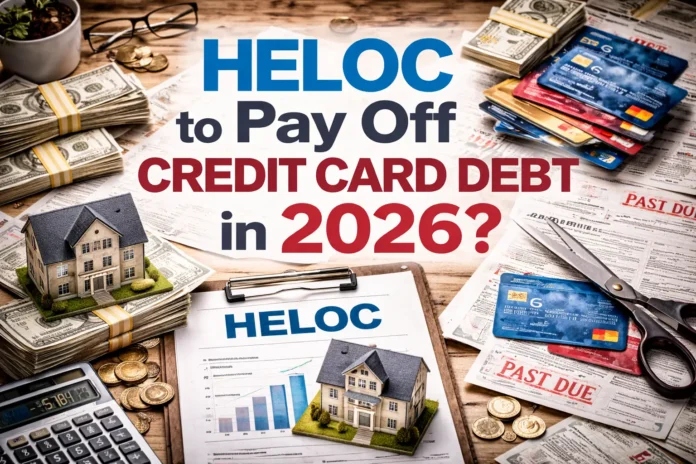
Credit card debt continues to be one of the most expensive forms of consumer borrowing. As interest rates remain elevated compared to historical norms and many credit card APRs exceed 20%, homeowners carrying significant revolving debt are increasingly looking for alternatives.
One strategy that continues to gain attention is using a Home Equity Line of Credit (HELOC) to pay off credit card balances. The appeal is easy to understand. HELOCs often offer lower interest rates than credit cards, potentially reducing monthly payments and helping borrowers regain control of their finances.
However, lower interest rates do not automatically mean a better financial outcome.
A HELOC can be a powerful debt-management tool in the right circumstances, but it can also create new risks that many homeowners fail to fully appreciate. In some cases, using home equity to pay off credit cards improves financial stability. In others, it merely relocates the debt while increasing long term exposure.
As homeowners evaluate debt solutions in 2026, understanding both the benefits and the dangers of this strategy is critical.
Why Homeowners Are Considering HELOCs for Debt Consolidation
Over the past several years, many households have faced a combination of financial pressures:
- Higher living costs
- Rising insurance premiums
- Increased housing expenses
- Elevated borrowing rates
- Persistent inflation
As budgets became strained, many consumers turned to credit cards to bridge gaps in cash flow.
What initially began as temporary borrowing often evolved into substantial revolving balances.
Today, many borrowers find themselves carrying:
- Multiple credit cards
- Double digit interest rates
- Large monthly minimum payments
- Balances that seem difficult to reduce
When homeowners discover they have significant equity available, a HELOC may appear to offer a practical solution.
Understanding How a HELOC Works
A Home Equity Line of Credit allows homeowners to borrow against the equity accumulated in their property.
Unlike a traditional loan, a HELOC functions similarly to a revolving credit line.
Borrowers receive:
- An approved credit limit
- Flexible access to funds
- The ability to draw funds as needed
Most HELOCs include:
Draw Period
During this phase, borrowers can access available funds.
Common draw periods range from:
- 5 years
- 10 years
- 15 years
Many lenders allow interest-only payments during this period.
Repayment Period
After the draw period ends:
- New borrowing stops
- Repayment begins
- Monthly obligations often increase
This structure creates flexibility but also introduces long term considerations that homeowners must evaluate carefully.
Why the Strategy Looks Attractive
At first glance, using a HELOC to pay off credit cards appears financially logical.
Consider the following example:
A homeowner carries:
- $30,000 in credit card debt
- Average APR of 24%
They qualify for a HELOC with a substantially lower interest rate.
The potential benefits appear significant:
- Lower monthly payments
- Reduced interest costs
- Simplified finances
- Faster debt payoff potential
Compared to paying 20% to 30% interest on revolving debt, the math can look compelling.
But numbers alone do not tell the entire story.
Benefit #1: Lower Interest Costs
The most obvious advantage is the possibility of reducing borrowing costs.
Credit cards are among the most expensive consumer debt products available.
Many borrowers pay:
- 18%
- 22%
- 25%
- 30% or more
depending on account terms and credit profiles.
A HELOC often carries lower rates than unsecured credit card debt.
Why This Matters
When less of each payment goes toward interest:
- More money reduces principal
- Balances decline faster
- Total borrowing costs decrease
For disciplined borrowers, lower interest costs can accelerate debt elimination significantly.
This is often the primary reason homeowners consider a HELOC for debt consolidation.
Benefit #2: Improved Monthly Cash Flow
High-interest credit card debt frequently creates cash-flow pressure.
Many borrowers juggle:
- Multiple due dates
- Numerous minimum payments
- Escalating monthly obligations
Consolidating balances through a HELOC may reduce monthly payment requirements.
This can provide:
- Budget flexibility
- Reduced financial stress
- Improved cash-flow management
For households struggling to keep up with multiple accounts, this simplification can be meaningful.
Benefit #3: Debt Simplification
Managing several credit cards simultaneously can become difficult.
Consumers may face:
- Different interest rates
- Multiple payment dates
- Various balances
- Complicated budgeting
A HELOC can consolidate these obligations into a single borrowing structure.
This often makes:
- Tracking balances easier
- Budgeting more straightforward
- Repayment planning more manageable
While simplification alone does not reduce debt, it can support better financial organization.
Benefit #4: Greater Repayment Control
Unlike many fixed loans, HELOCs often provide flexibility.
Borrowers may choose to:
- Pay more when income increases
- Reduce borrowing when possible
- Access funds if emergencies arise
This flexibility can be valuable for homeowners with variable income or changing financial circumstances.
However, flexibility is a double edged sword.
The same feature that provides convenience can also create temptation.
The Biggest Risk: Turning Unsecured Debt Into Secured Debt
One of the most important considerations is often overlooked.
Credit card debt is generally unsecured.
This means the debt is not directly tied to a specific asset.
A HELOC is different.
A HELOC is secured by the home.
Why This Changes the Risk Profile
When homeowners use a HELOC to pay off credit cards, they are effectively converting:
- Unsecured debt
into
- Home secured debt
The interest rate may decline.
The monthly payment may improve.
But the consequences of repayment problems become much more serious.
Financial difficulties that once affected credit card accounts can now potentially affect housing security.
This is one of the most significant trade offs associated with the strategy.
The Behavioral Problem Most Borrowers Ignore
The success of a HELOC consolidation depends heavily on behavior.
Many homeowners focus on the interest-rate savings while overlooking spending patterns.
Consider what often happens:
- Credit card balances are paid off.
- Available credit becomes accessible again.
- Spending resumes.
- New balances accumulate.
The result?
The borrower now has:
- HELOC debt
- New credit card debt
Instead of solving the problem, debt has expanded.
Why This Happens
Debt consolidation addresses:
- Debt structure
It does not automatically address:
- Spending habits
- Budgeting weaknesses
- Cash flow problems
Without behavioral changes, consolidation can create a false sense of financial progress.
The debt moves.
The underlying issue remains.
When a HELOC Makes Sense
A HELOC may be a reasonable option under specific circumstances.
Examples include:
Strong Financial Discipline
Borrowers who:
- Follow budgets
- Track spending carefully
- Avoid unnecessary borrowing
are more likely to benefit.
Stable Income
Consistent income supports reliable repayment.
Homeowners with predictable earnings generally face lower risk.
Significant Credit Card Interest Burdens
The larger the difference between:
- Credit card rates
and - HELOC rates
the greater the potential savings.
A Clear Repayment Plan
Successful borrowers often enter consolidation with a specific timeline and payoff strategy.
They treat the HELOC as a debt elimination tool rather than an ongoing borrowing resource.
When a HELOC May Be a Bad Idea
The strategy deserves caution when:
Spending Problems Remain Unresolved
If credit card debt resulted from chronic overspending, consolidation may simply postpone future difficulties.
Income Is Uncertain
Variable income can make repayment challenging.
Since the home secures the debt, financial instability increases risk.
Emergency Savings Are Minimal
Without adequate reserves, unexpected expenses often lead to renewed borrowing.
This can restart the debt cycle.
Borrowing Is Used for Lifestyle Preservation
Some households use debt to maintain spending levels that exceed income.
A HELOC cannot permanently solve a cash-flow imbalance.
The Variable Rate Risk in 2026
Most HELOCs have variable interest rates.
This means borrowing costs can change over time.
Many consumers focus on current rates without considering future adjustments.
Potential consequences include:
- Higher monthly payments
- Increased borrowing costs
- Budget uncertainty
A strategy that appears attractive today may become less advantageous if rates rise substantially.
Understanding rate adjustment terms is essential before committing to any HELOC.
HELOC vs Personal Loan for Credit Card Debt
Homeowners often compare HELOCs with personal loans.
Each option has advantages.
HELOC Advantages
- Potentially lower rates
- Flexible borrowing access
- Larger borrowing limits
HELOC Drawbacks
- Variable rates
- Home secured debt
- Greater housing related risk
Personal Loan Advantages
- Fixed payments
- Fixed interest rates
- No home collateral
Personal Loan Drawbacks
- Higher rates than some HELOCs
- Smaller loan amounts
- Less flexibility
The right choice depends on financial circumstances, risk tolerance and repayment goals.
HELOC vs Cash Out Refinance
Some homeowners also consider cash-out refinancing.
Both strategies access home equity but operate differently.
HELOC
- Separate credit line
- Existing mortgage remains unchanged
- Flexible borrowing
Cash Out Refinance
- Replaces current mortgage
- Creates a new mortgage balance
- Typically provides lump sum funds
In 2026, many homeowners are reluctant to refinance low rate mortgages obtained in previous years.
As a result, HELOCs may appear more attractive because they preserve existing mortgage terms.
However, preserving a low mortgage rate should not overshadow the broader debt-management analysis.
Questions to Ask Before Using a HELOC for Debt Consolidation
Before moving forward, homeowners should ask:
Why Did the Credit Card Debt Accumulate?
Understanding the root cause matters.
Was it:
- Temporary hardship?
- Medical expenses?
- Job loss?
- Overspending?
Different causes require different solutions.
Can I Avoid Rebuilding Credit Card Balances?
Consolidation succeeds only if debt does not return.
How Long Will Repayment Take?
Many borrowers focus on monthly payments while ignoring total repayment timelines.
Can My Budget Handle Future Rate Increases?
Variable-rate borrowing requires stress testing future affordability.
What Happens If My Financial Situation Changes?
A debt strategy should remain sustainable under less favorable conditions.
Common Mistakes Homeowners Make
Several errors frequently undermine consolidation efforts.
Focusing Only on Monthly Payments
Lower payments do not necessarily mean lower long term costs.
Borrowing the Maximum Available Amount
Approval limits should not determine borrowing decisions.
Ignoring Emergency Savings
Unexpected expenses often trigger renewed debt accumulation.
Keeping the Same Spending Habits
Without behavioral changes, debt frequently returns.
Underestimating Housing Risk
Using home equity introduces stakes that credit cards do not.
The Long Term Financial Perspective
The real question is not:
“Can a HELOC pay off my credit cards?”
The answer is obviously yes.
The more important question is:
“Will using a HELOC improve my overall financial position five years from now?”
That answer depends on:
- Spending behavior
- Repayment discipline
- Income stability
- Interest rate conditions
- Long term financial planning
The best debt solutions address both the numbers and the behaviors behind them.
Using a HELOC to pay off credit card debt in 2026 can be an effective strategy for certain homeowners. Lower interest rates, improved cash flow, simplified finances and accelerated repayment potential are all legitimate advantages.
However, these benefits come with meaningful risks. Converting unsecured debt into debt secured by the home changes the consequences of financial hardship. Variable rates introduce uncertainty and unresolved spending habits can quickly undermine the entire strategy.
For disciplined borrowers with stable income, substantial equity, and a clear repayment plan, a HELOC may provide a path toward lower borrowing costs and faster debt elimination. For others, it may simply relocate debt while increasing long term financial exposure.
Ultimately, the success of a HELOC based debt consolidation strategy depends less on the credit line itself and more on what happens after the credit card balances are paid off. The homeowners who benefit most are those who use the opportunity to permanently improve their financial habits, not merely reorganize their debt.