Debt repayment is often discussed as a numbers problem, but for most consumers it becomes a behavioral challenge long before it becomes a mathematical one. Interest rates, balances, minimum payments, and repayment timelines matter, yet the strategy that succeeds in practice is usually the one a borrower can consistently maintain over time.
Two of the most recognized debt repayment methods are the debt snowball and the debt avalanche. Both approaches are structured systems for paying down multiple debts, but they prioritize balances differently and appeal to different financial behaviors.
For homeowners already managing mortgages, refinancing decisions, HELOC obligations, or rising household costs, choosing the right repayment structure can significantly affect financial stability. The wrong approach can increase repayment fatigue, while the right one can improve consistency, confidence and long term budgeting discipline.
Understanding the Debt Snowball Method
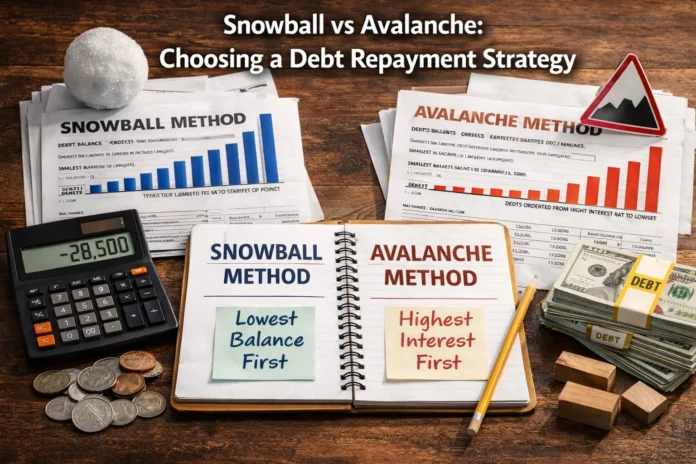
The debt snowball strategy focuses on paying off the smallest balances first, regardless of interest rate.
Under this method:
- Minimum payments are maintained on all debts.
- Extra funds are directed toward the smallest balance.
- Once that debt is eliminated, the payment amount “snowballs” into the next smallest debt.
For example, a borrower with:
- A $500 medical bill
- A $2,000 credit card balance
- A $10,000 personal loan
would focus on eliminating the $500 balance first, even if the personal loan carries a higher interest rate.
The primary advantage of this approach is psychological momentum. Early wins can create a sense of progress that encourages borrowers to remain committed to repayment.
Why the Snowball Method Appeals to Many Consumers
Debt repayment often involves emotional exhaustion. Consumers carrying multiple balances may experience:
- Financial anxiety
- Decision fatigue
- Budget frustration
- Reduced motivation after slow progress
The snowball method attempts to counter those pressures by producing visible milestones quickly.
Many borrowers abandon repayment plans not because the math fails, but because the process feels endless. Eliminating smaller accounts early can reduce mental stress and simplify monthly financial management.
For borrowers dealing with inconsistent income, financial stress or low savings buffers, this emotional reinforcement can become extremely important.
Understanding the Debt Avalanche Method
The debt avalanche strategy prioritizes the highest interest rates first.
Under this system:
- Minimum payments are made on all debts.
- Extra money is directed toward the highest-interest debt.
- Once that balance is eliminated, the repayment amount shifts to the next highest interest rate.
This strategy is mathematically efficient because it minimizes total interest paid over time.
For example:
- Credit card at 28% APR
- Personal loan at 12% APR
- Auto loan at 5% APR
The avalanche method targets the 28% credit card first, even if its balance is larger than other obligations.
Why the Avalanche Method Is Financially Efficient
High-interest debt compounds aggressively over time. Credit cards, payday style financing, and unsecured personal loans can dramatically increase repayment costs if balances linger for years.
The avalanche method reduces:
- Total interest expenses
- Long term repayment timelines
- Cumulative borrowing costs
Consumers with strong budgeting discipline often benefit most from this approach because they can tolerate slower emotional rewards in exchange for better long term financial outcomes.
From a pure numerical perspective, avalanche repayment is usually the cheaper option.
The Behavioral Difference Between Both Strategies
The biggest difference between snowball and avalanche repayment is not mathematical, it is behavioral.
The snowball method prioritizes motivation.
The avalanche method prioritizes efficiency.
This distinction matters because personal finance decisions are rarely made in ideal conditions. Borrowers may be navigating:
- Job uncertainty
- Rising living expenses
- Emergency costs
- Mortgage obligations
- Inflation pressure
- Variable income
In these situations, emotional sustainability can become just as important as repayment optimization.
A borrower who quits an avalanche strategy after four months may ultimately perform worse than someone who consistently follows a snowball strategy for three years.
When the Snowball Method May Be More Effective
The snowball strategy may work better for consumers who:
- Feel overwhelmed by multiple balances
- Need fast psychological wins
- Have struggled with repayment consistency
- Frequently lose motivation
- Want to simplify monthly obligations quickly
This approach can also help borrowers reduce account fragmentation. Eliminating smaller balances lowers the number of active payments, which may reduce missed payment risk.
For consumers recovering from financial instability, emotional consistency often matters more than interest optimization in the early stages of repayment.
When the Avalanche Method May Be More Effective
The avalanche method may be more suitable for consumers who:
- Have strong budgeting habits
- Are highly disciplined financially
- Carry extremely high interest debt
- Want to minimize total repayment costs
- Have stable income and emergency savings
Borrowers with large revolving credit card balances may save substantial amounts in interest through avalanche prioritization.
For homeowners balancing mortgage payments alongside unsecured debt, reducing high-interest liabilities quickly may improve overall cash flow resilience.
The Role of Interest Rates in Long Term Financial Risk
Interest rates significantly affect how long debt remains active.
A consumer making minimum payments on a high-interest balance may spend years repaying relatively small original debts. This extended repayment cycle increases exposure to:
- Emergency borrowing
- Credit utilization damage
- Refinancing difficulty
- Reduced savings growth
High-interest debt can also interfere with broader financial goals, including:
- Mortgage refinancing eligibility
- HELOC qualification
- Emergency fund development
- Retirement contributions
Consumers sometimes underestimate how quickly interest accumulation can destabilize long-term financial planning.
Why Debt Repayment Plans Often Fail
Most repayment failures are not caused by poor strategy selection alone.
They usually result from:
- Unrealistic budgeting
- Lack of emergency savings
- Income instability
- Unexpected expenses
- Psychological burnout
- Overly aggressive repayment targets
Many borrowers create repayment plans that leave no financial breathing room. When emergencies occur, debt balances often rise again.
A sustainable repayment strategy should account for:
- Emergency expenses
- Variable monthly costs
- Insurance increases
- Housing inflation
- Medical expenses
- Seasonal spending patterns
Without flexibility, even mathematically strong repayment systems can collapse under financial stress.
How Homeowners Should Think About Debt Repayment
Homeowners face additional layers of financial complexity compared to renters or consumers without secured assets.
Mortgage obligations, property taxes, insurance costs, maintenance expense and potential refinancing decisions all compete for cash flow.
For homeowners, debt repayment strategies should be evaluated alongside:
- Mortgage interest rates
- Existing HELOC balances
- Home equity levels
- Emergency reserve strength
- Refinancing goals
For example, aggressive unsecured debt repayment may improve debt-to-income ratios, potentially strengthening future refinance eligibility.
However, depleting all available cash toward debt repayment while neglecting emergency reserves can create new financial vulnerabilities.
The Psychological Cost of Long Term Debt
Long term debt pressure affects more than monthly finances.
Research and consumer behavior trends consistently show that persistent debt stress can contribute to:
- Financial avoidance behavior
- Delayed decision making
- Reduced savings participation
- Emotional fatigue
- Increased reliance on short term credit
The structure of a repayment strategy can influence whether consumers feel trapped or empowered during the repayment process.
This is one reason why the “best” repayment method is not always universal. The optimal strategy depends on both financial math and behavioral sustainability.
Can Consumers Combine Both Methods?
Some borrowers use hybrid approaches that combine elements of snowball and avalanche repayment.
Examples include:
- Paying off one or two small balances first for momentum, then switching to avalanche repayment
- Prioritizing high interest debt while simultaneously eliminating nuisance balances
- Using seasonal income boosts to accelerate specific debts
Hybrid systems can improve flexibility while still reducing interest exposure.
For borrowers dealing with financial burnout, rigid repayment structures may be harder to sustain than adaptive systems.
The Importance of Emergency Savings During Repayment
One of the most overlooked aspects of debt repayment is emergency preparedness.
Consumers sometimes direct every extra dollar toward debt while maintaining little or no emergency reserve. This creates vulnerability when:
- Medical costs arise
- Income declines
- Home repairs occur
- Insurance deductibles increase
- Vehicle repairs become necessary
Without emergency liquidity, consumers often return to credit card borrowing, restarting the debt cycle.
Even modest emergency savings can reduce dependence on revolving debt during financial disruptions.
Choosing the Right Strategy for Your Situation
There is no universally perfect debt repayment method.
The right approach depends on:
- Financial discipline
- Emotional motivation
- Debt composition
- Interest rates
- Income stability
- Household obligations
- Risk tolerance
Consumers who need visible progress may benefit from the snowball strategy.
Consumers focused on minimizing interest costs may prefer the avalanche method.
The most important factor is consistency. A sustainable repayment strategy that survives economic pressure is often more valuable than an aggressive plan that fails after several months.
Final Thoughts
The debate between snowball and avalanche repayment methods reflects a broader reality about personal finance: successful financial recovery depends on both mathematics and behavior.
The avalanche method may reduce total borrowing costs more efficiently, but the snowball method may improve motivation and long-term consistency for certain borrowers.
For homeowners balancing mortgages, refinancing considerations, rising insurance expenses, and broader household costs, debt repayment should be approached as part of an overall financial stability strategy rather than a short term budgeting exercise.
Choosing a repayment system is ultimately less about finding a universally superior method and more about selecting a structure that can realistically survive changing financial conditions over time.
In another related article, What Happens When Consumers Use New Debt to Solve Existing Debt