
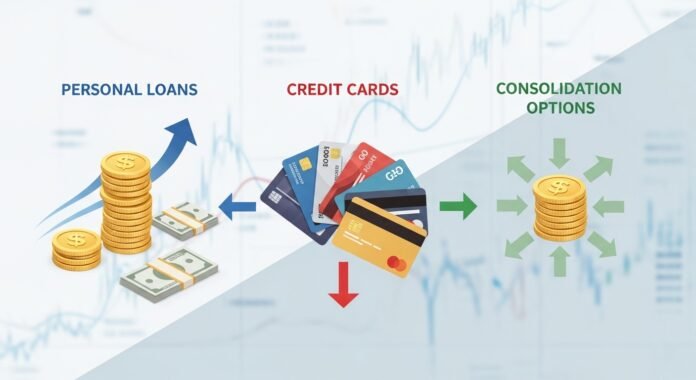
When debt starts building up, most people end up looking at the same three tools: personal loans, credit cards, and debt consolidation options. On the surface they all seem to do the same thing, but the way they work (and what they cost you over time) is very different.
Choosing the wrong one usually doesn’t show up immediately. It shows up months later in higher interest, tighter cash flow or a credit score that moves in the wrong direction.
Here’s a clear breakdown of how they actually compare.
1. Personal Loans: structured and predictable
A personal loan is one of the most straightforward ways to consolidate debt. You borrow a fixed amount and repay it in fixed monthly installments over a set period.
The biggest advantage is predictability. You know exactly what you owe and when you’ll be done.
A=P(1+r)n−1r(1+r)n
This formula is what lenders use to calculate fixed loan repayments, where your monthly payment stays consistent even if your budgeting gets easier over time.
Pros:
- Fixed interest rate and payment
- Clear payoff timeline
- Often lower interest than credit cards
Cons:
- Requires approval based on credit profile
- Can come with origination fees
- Doesn’t help if spending habits don’t change
Best for: people who want structure and a clean exit plan from multiple debts.
2. Credit Cards: flexible but expensive if unmanaged
Credit cards are the most accessible form of borrowing, but also the easiest to misuse.
They’re useful for short term borrowing or emergencies but they become costly when balances carry over month to month.
Interest=Balance×12/APR
That simple structure explains why credit card debt grows quickly. Interest is calculated monthly on whatever balance you leave unpaid.
Pros:
- Easy access to credit
- Useful for short-term or emergency spending
- Can offer rewards or cashback
Cons:
- High interest rates
- No fixed repayment timeline
- Debt can grow quickly if only minimum payments are made
Best for: short-term needs that you can fully repay quickly, not long term debt.
3. Debt consolidation options: combining and restructuring
Debt consolidation isn’t a single product. It’s a strategy. It usually involves combining multiple debts into one of the following:
- Personal loan consolidation
- Balance transfer credit cards
- HELOC based consolidation
The goal is not just combining debt, but improving repayment conditions.
Debt to Income Ratio=Monthly Income/Monthly Debt Payments
This ratio is important because lenders use it to evaluate how manageable your debt load is. Consolidation often helps lower this number by simplifying payments or reducing interest costs.
Pros:
- Can reduce overall interest paid
- Simplifies multiple payments into one
- May improve cash flow management
Cons:
- Doesn’t reduce debt automatically
- May require good credit to qualify for better terms
- Can backfire if new debt is added afterward
Best for: people juggling multiple debts who want better control and potentially lower interest.
How they really compare in practice
Here’s the simplest way to think about it:
- Personal loans = structure and discipline
- Credit cards = flexibility but high cost risk
- Consolidation = strategy, not a product
The best choice depends less on the tool itself and more on how stable your income and spending habits are.
If you need predictability, personal loans usually win.
If you need flexibility for very short-term borrowing, credit cards can work.
If your main issue is managing multiple debts, consolidation is usually the smartest starting point.
Final takeaway
There’s no “perfect” option here, only trade offs. Most financial stress doesn’t come from the type of debt itself, but from mismatching the tool to the situation.
The key is not just getting out of debt but making sure the structure you move into doesn’t recreate the same problem later.